


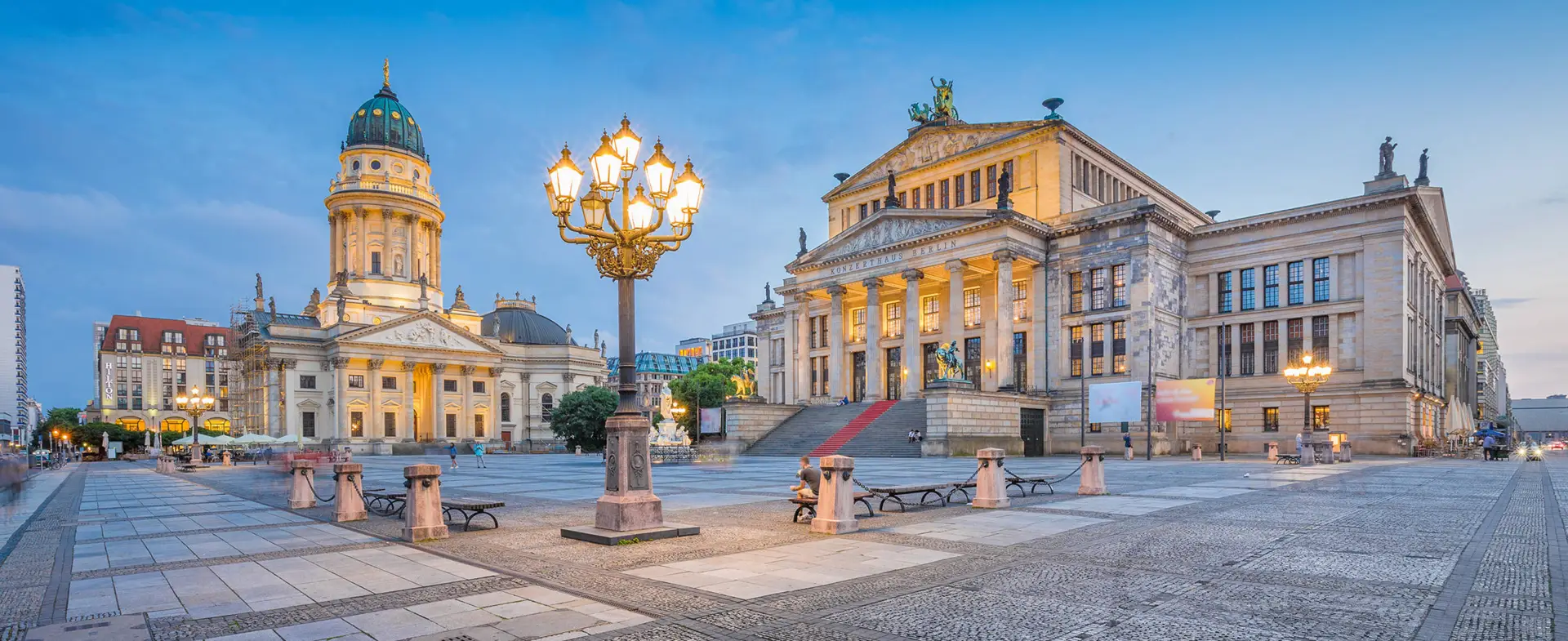
The Gendarmenmarkt - considered the most beautiful square in Berlin
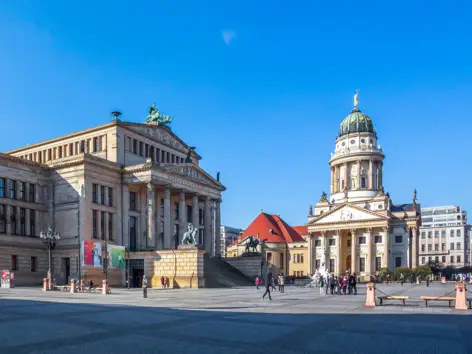
Gendarmenmarkt
The Gendarmenmarkt has the reputation of being the most beautiful square in Berlin. The square is home to the French and German Cathedrals, a classicist trio that frame the Konzerthaus.
On the sides of the French and German cathedrals and their domed towers, trees and bushes with benches provide a green border to the square. Its origins go back to French immigrants, especially the Huguenots. They were granted citizenship and the freedom to practice their religion by the Great Elector Frederick William of Brandenburg and settled here.
The Gendarmenmarkt was created in the 17th century as the center of Friedrichstadt. Friedrichstadt, which was planned as a suburb, was absorbed into Berlin at the beginning of the 18th century. The square was designed by the Brandenburg master builder Johann Arnold Nering. Initially known as Lindenmarkt, the square changed its name over the years until the name Gendarmenmarkt finally prevailed.
Since the end of the 18th century, it has been named after the guard regiment, the Gens d'armes. In the middle of the 18th century, the guard and stables of the cuirassier regiment, the armored horsemen of the soldier king, were located here. The Gendarmenmarkt can be reached by subway, S-Bahn and bus. The stations Französische Straße, Hausvogteiplatz and Stadtmitte are suitable for this.
If you are arriving by car, the streets branching off from Gendarmenmarkt or parking garages are ideal for parking. Friedrichstraße and Leipziger Straße, two of the largest streets in the center of Berlin, are in the immediate vicinity.
Book your hotel on H-Hotels.com for your stay in Berlin. We offer you the following advantages:
- Book hotels in Berlin at the best price
- Berlin hotels can be booked without a credit card
- Minibar included in all HYPERION Hotels
- Breakfast included in all H2 Hotels
From the market to Berlin's most beautiful square
The area around the market had been a residential area for Huguenots since the 18th century. The French Reformed and German Lutheran communities were therefore given permission to build churches there. Today's buildings have little in common with the churches of that time. These were originally simple churches for worship.
At the end of the 18th century, the architect Carl von Gontard and Georg Christian Unger gave the churches towers as representative buildings. The name "cathedral" is derived from these domed towers. Where the concert hall stands today was originally the site of the National Theater.
After a fire, Karl Friedrich Schinkel built the Schauspielhaus there at the beginning of the 19th century, which is now the Konzerthaus. The Gendarmenmarkt was important for Prussia because of the cuirassier regiment, the representative layout of the towers and the playhouse. The stables disappeared in 1773 and the representative redesign followed in the coming years.
Important events in Berlin's history took place on the square in the center of the city: A very Berlin revolution was the so-called potato revolution, which began on the Gendarmenmarkt. The high potato prices led to protests by citizens and their arrests. Fierce barricade battles for freedom and democracy took place here during the March Revolution in 1848. A memorial plaque at the German Cathedral commemorates these events.
In the hands of the National Socialists, the square with its green spaces was transformed into a parade ground. The large square slabs and their pattern are a legacy of this conversion work. All three buildings suffered severe damage during the Second World War. During the division of Germany, Gendarmenmarkt belonged to East Berlin as part of the Berlin Mitte district and was given the name Platz der Akademie. The name was changed in 1950 to mark the 250th anniversary of the Academy of Sciences.
in 1990, the last state ceremony of the GDR government took place on Gendarmenmarkt. Today it is a round-the-clock attraction for tourists and Berliners alike.

Historical events at Gendarmenmarkt
Sights at Gendarmenmarkt
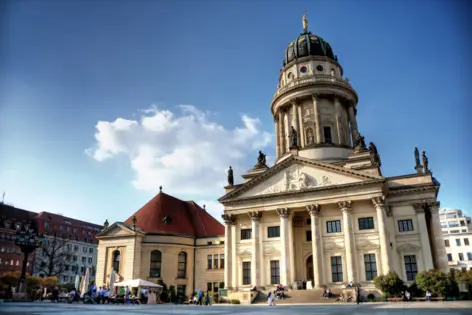
French Cathedral

Schiller monument
The Huguenot Museum is located in the French Cathedral. In the German Cathedral, an exhibition of the German Bundestag provides information about the history of parliamentary democracy in Germany. While the German Cathedral no longer has an ecclesiastical function, the French Cathedral houses the French Friedrichstadt Church at the lower part of the building. The name French Cathedral refers only to the building with the domed tower.
The entrance to the Friedrichstadtkirche is on Charlottenstraße. Services are held in the church every Sunday at half past nine according to the Protestant order and eleven o'clock according to the Reformed order. The church is open for visitors and tours when there are no events taking place. The two cathedrals and towers were badly damaged after the Second World War. Following reconstruction, the domed tower of the French Cathedral now houses the second largest carillon in the capital as well as a viewing platform. However, the French Cathedral is expected to be closed until 2019 due to construction work.
The Schiller monument designed by Reinhold Begas stands in front of the concert hall. Erected to mark the 100th birthday of Friedrich Schiller, it was removed by the National Socialists. The Schiller monument only returned to its original location in 1987. The figure of Friedrich Schiller is accompanied by four female figures, which are allegories for various literary genres.
The Konzerthaus in its tripartite structure was designed by Karl Friedrich Schinkel. Numerous figures can be seen on the façade. They were created by the sculptors Christian Daniel Rauch and Friedrich Tieck. On the main façade, mythological figures and the muses take up the themes of theater, art and music. The façade suffered severe damage from bombs and fires during the Second World War. The restoration and renovation work lasted until the 1990s.
A look inside the various concert halls is not only possible in connection with a concert or visit to other events. The Konzerthaus regularly offers free tours.
Cafés, restaurants, bars and hotels have sprung up around the Gendarmenmarkt, offering guests affordable lunches or fine dining. The Regent Hotel on Charlottenstraße is home to the Charlotte & Fritz restaurant. It has been awarded two Michelin stars and when you eat at the hotel, you get a unique view of the Gendarmenmarkt for free.
Christmas magic and Classic Open Air
For many visitors, the Christmas market on Gendarmenmarkt is also the most beautiful in the capital. For a small entrance fee, you can experience the magic of Christmas at the Christmas market, complete with dressed-up angels, carol singers and arts and crafts in December.
In summer, the square is the venue for the Classic Open Air event. A series of concerts takes place in front of the Konzerthaus, ranging from Chopin to versions of famous film music. Many of the sights of central Berlin are a short walk from Gendarmenmarkt. These include the State Opera, Berlin Cathedral, Museum Island and the Brandenburg Gate. Friedrichstrasse is also nearby , with numerous stores for shopping or Checkpoint Charlie, the border crossing between East and West Berlin.
Another street close to the Gendarmenmarkt is Leipziger Straße. It leads past the Museum of Communication, the Square of the People's Uprising of 1953 and the Bundesrat to Potsdamer Platz.

Christmas market on the Gendarmenmarkt