


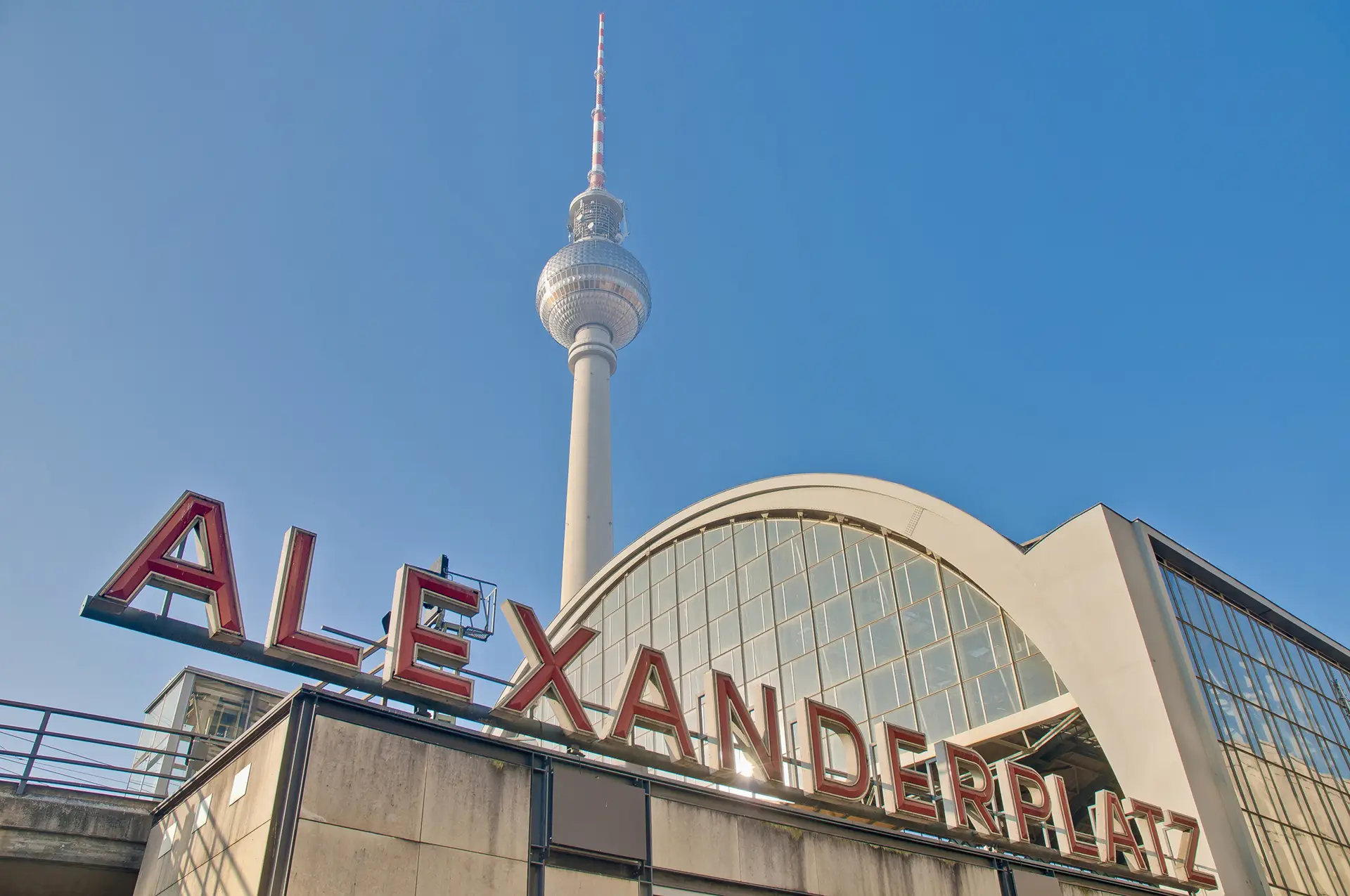
Alexanderplatz - visit the Weltzeituhr and go shopping
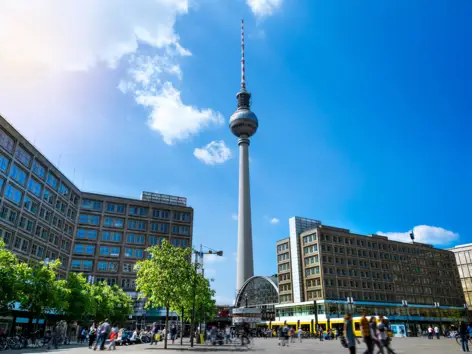
Alexanderplatz - The busiest square in Berlin
Alexanderplatz is one of the busiest and most visited squares in Berlin. It is a central transportation hub from which Berlin can be explored by train and bus or on foot. One of the capital's most famous landmarks is located directly on Alexanderplatz: the television tower.
Apart from the TV tower, there are other architectural and technical monuments on the square, which Berliners call "Alex" for short. These include the Berolina House, the Fountain of Friendship between Nations and the World Time Clock. The historic center of Berlin, the Nikolai Quarter, is just a stroll away.
In addition to classic sightseeing, the Alex fulfills almost every big city wish. Here, shopping center follows restaurant follows bar follows hotel. A new store or café is constantly opening, making the square a symbol of the city: Berlin is constantly reinventing itself and is full of life. Although the square is not one of the most beautiful squares in the capital, its central location makes it one of the most popular. Its architecture and hustle and bustle create an impressive effect.
Book your hotel on H-Hotels.com for your stay in Berlin. We offer you the following advantages:
- Book hotels in Berlin at the best price
- Berlin hotels can be booked without a credit card
- Minibar included in all HYPERION Hotels
- Breakfast included in all H2 Hotels
From the market to Berlin's busiest square
Alexanderplatz looks back on a long history. In the 19th century, traders and farmers sold their goods here and the military used it as a parade ground. It was given its current name in 1805 on the occasion of a visit by the Russian Tsar Alexander. It developed into an important transportation hub with the construction of the long-distance railway station. The construction and opening of Europe's largest department store, the Tietz department store, at the beginning of the 20th century provided a further attraction.
Alfred Döblin's novel "Berlin Alexanderplatz" made the square world-famous. Traces of the square's earlier history fell victim to the Second World War. The Second World War and its destruction led to a redesign of the square. Only the Alexander House and the Berolina House from the 1930s have been preserved.
The Centrum department store, which today houses Galeria Kaufhof, and the surrounding high-rise buildings that frame the square were built in the GDR. The television tower, the World Time Clock and the Fountain of Friendship between Nations are also a legacy of the redesign in the GDR. Anyone standing on Alex today will hardly find any traces of the historical events that took place here.
The everyday crowds of people give an idea that it has always been one of the city's most important squares. It was here that the demonstrators gathered in November 1989, who ultimately had a major influence on the fall of the Wall and the reunification of Germany and Berlin. Alexanderplatz is still the starting point for many demonstrations today.
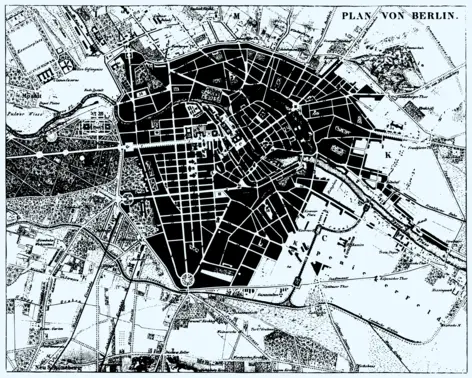
Map of Berlin around 1851
Sights on Alexanderplatz
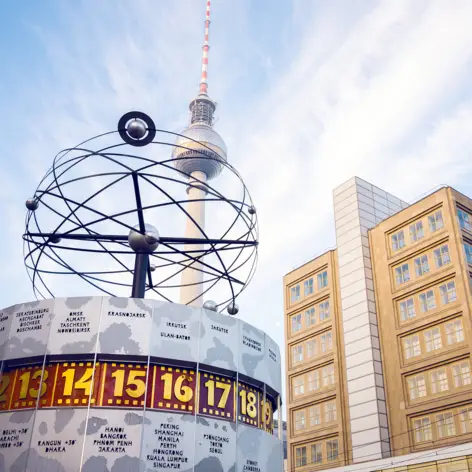
Television tower and world clock at Alexanderplatz
The TV Tower and the World Time Clock (Weltzeituhr) are among the most popular sights on Alexanderplatz. However, the television tower is not located on Alexanderplatz, but behind it. The layout of the square and the adjacent buildings are also worth seeing architecturally.
The square is surrounded by various high-rise buildings that are prime examples of socialist architecture. The Haus des Reisens, the Haus des Lehrers and the Kongresshalle are located on Alexanderstraße, which borders Alex to the north-east. The frieze on the Haus des Reisens and the mosaic on the Haus des Lehrers are well worth seeing. Both houses are listed buildings and the decorations are the work of the artist Walter Womacka.
The listed Alexanderhaus and Berolinahaus are located directly on the square and are the only buildings to have been preserved after the Second World War. They are known as the Behrens buildings, after their architect Peter Behrens, and are an example of functional architecture. Today, the buildings house various stores and offices. Behind the Berolinahaus is the S-Bahn station and below the entire Alex is the U-Bahn, which can be reached via various entrances. The underground corridors of the three subway lines are like a labyrinth, especially for visitors and the inexperienced. This is because the subway station is one of the largest subway stations in Berlin.
In the middle of the square is the Fountain of Peoples' Friendship (Brunnen der Völkerfreundschaft), whose wide rim serves as a bench and meeting place in good weather. If you walk through the S-Bahn station building, you will reach the television tower. In addition to cafés, restaurants and souvenir stores, the Menschen Museum has found a home in the substructure of the television tower.
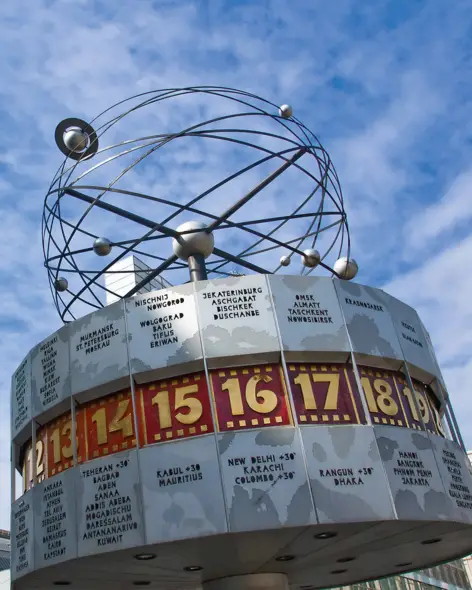
The world clock | Weltzeituhr
The Weltzeituhr on Alexanderplatz is both a landmark and a popular meeting place. It stands in front of the Alexanderhaus. At a height of ten meters, it is easy to overlook, but it is recognizable by the way different people gather in groups in front of and below it. It was already a meeting place for tourists and Berliners during the GDR. The GDR civil rights activists also met here for their demonstrations before the fall of communism.
The clock has been showing the time in different countries since 1969. It was designed by Erich John and is a listed building. Another name is the Urania World Time Clock. This name was given to it by the press at the time and the fact that the workers found a Urania column during the construction work for the clock.
The centerpiece of the clock is the depiction of the world map and world time. The world time clock consists of a column and a cylinder whose 24 segments correspond to the time zones and a movable ring for the hours. The hour ring shows the current time. The segments consist of aluminum plates, each of which is designed with city names and sections of the world map. The more than 100 city names show the local time and local times of cities around the world. After the fall of communism, additional cities such as Tel Aviv were added to the clock's illustrations.
Below the actual display with the city names and the different time zones of the countries, there is a mosaic in the form of a compass rose on the base. Above the cylinder is a representation of the solar system with spheres and steel circles, which rotates on its own axis. The electronics responsible for the operation of this technical attraction are located directly under the column and the compass rose in a small room.
Incidentally, it does not know the time changeover and always displays winter time for world time. The current time, even during summer time, can be read on the clocks attached to the column. One of the legends in Berlin is that couples who hold hands at midnight at Alexanderplatz under the World Time Clock will stay together forever.
The television tower at Alexanderplatz | TV Tower | Fernsehturm Berlin
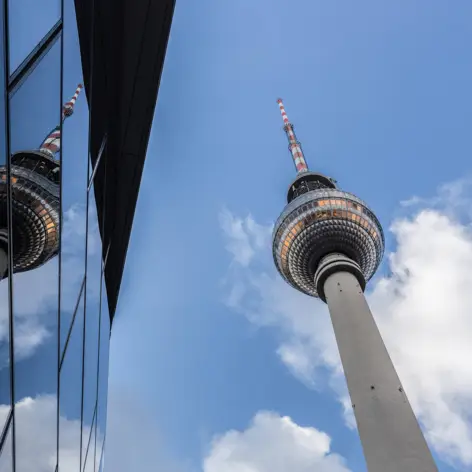
Television tower
One of Berlin's best-known landmarks is the television tower. For many Berliners, it serves as a landmark, as the silver sphere of the tower can be seen from afar in almost every part of the city.
Originally built to symbolize the supposed superiority of socialist society, today it is a symbol for the entire city. It is 368 meters high and is the tallest publicly accessible building in Europe. Especially on a clear day, visitors have an all-round view of Berlin through the windows of the viewing platform at a height of 200 meters. In some places, the view extends as far as the forests and meadows of Brandenburg. One floor above the viewing platform at a height of 207 meters, the Sphere revolving restaurant offers a special combination of views and food.
The tower has been a listed building since 1979. Apart from the opportunity to enjoy a beautiful view from the tower, it is also technically and architecturally impressive. Its practical use today is as an antenna mast for television and radio stations. The tower is one of Berlin's most popular sights and attracts millions of visitors every year. To visit it, it is advisable to allow for a waiting time or book tickets in advance.
The fountain of international friendship | Brunnen der Völkerfreundschaft
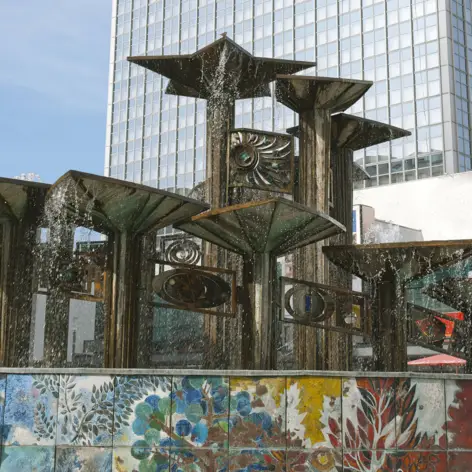
The centerpiece of Alexanderplatz is the Fountain of Friendship between Nations, even if it is not located directly in the middle of the square. Since 1970, water has been gushing from a spiral into the 17 bowls from spring to fall. The bowls and the flowing water symbolize the friendship between the many peoples. The edge of the fountain offers the opportunity to sit down and take in the hustle and bustle of Alexanderplatz.
The fountain was designed by the artist Walter Womacka. The installation is made of copper, glass, ceramic and enamel and offers a play of colors in the right light. The fountain basin is decorated with a mosaic of plant and animal motifs. The complex has been a listed building since the 1980s. To the north, a high-rise building borders Alexanderplatz, which houses stores and a hotel.
If you look up to the roof, you will have the opportunity to watch people plunging from this skyscraper. There is a base flyer on the 125-metre-high roof for those who want to experience the square in free fall.
Shopping, dining and nightlife in one place

Numerous activities at Alexanderplatz
Alexanderplatz is one of the busiest squares in Berlin because it caters to almost every need. Seasonal events such as an Easter market, children's festival, Oktoberfest or Christmas market take place directly on the square every year.
Numerous stores, cafés and restaurants are located in the surrounding buildings. In the evenings, coffee drinkers alternate with bar visitors. In addition to bars, there are cinemas, clubs and karaoke bars in the immediate vicinity. In the Haus des Reisens, the House of Weekend is a night bar with a roof terrace where you can combine the nightlife on Alex with a club atmosphere. The Besenkammer, one of Berlin's oldest gay bars, has become an institution on Alexanderplatz. It is located under the S-Bahn arches behind the Behrensbauten.
Its central location makes it easy for many night owls to return home or to their hotel by train. At weekends, the BVG subway, streetcars and buses provide round-the-clock transportation home. During the day, evening and night, numerous snack bars and mobile sausage vendors offer a wide selection of snacks. Restaurants can also be found on Alex. One way to enjoy Alexanderplatz from above while eating is at the Galeria Kaufhof department store. There is a restaurant on the top floor and seats right by the window.
It is impossible to overlook the Alex as a center for shoppers and one of the most popular shopping areas in the city. In addition to Galeria Kaufhof, the Berolinahaus also houses a branch of a fashion company. Opposite the Alexanderhaus is "Die Mitte", a building housing various flagship stores and electronics stores. One of Berlin's largest shopping centers, the ALEXA, is located in the immediate vicinity of Alexanderplatz. In addition to the television tower, the Alea 101 shopping center and the Rathauspassagen shopping arcades offer further shopping opportunities.
Transport hub and starting point for discovering Berlin
Alexanderplatz is a hub for many means of public transport and roads. Trains and buses run from here to destinations throughout Germany and other European countries. Every day, a quarter of a million people travel on the S-Bahn, U-Bahn, streetcars and buses that start and stop at Alex.
Sightseeing buses also stop here. Visitors to Berlin who want to experience Berlin can take the BVG bus lines 100 or 200 for an inexpensive city tour. The 100 runs from Alexanderplatz to the Zoological Garden, via Berlin's most famous street "Unter den Linden" through the government district past the Reichstag and Bellevue Palace. The 200 also terminates at the Zoologischer Garten, but also stops at Potsdamer Platz.
Many of Berlin's other landmarks can be reached from the underground and S-Bahn stations at Alexanderplatz. Some of them are close by, so in good weather Alex is a good starting point for a discovery tour on foot. Directly behind the TV tower, the Rotes Rathaus, St. Mary's Church and the Neptune Fountain are all within a five-minute walk.
If you keep left from the Rotes Rathaus, you will reach the Nikolai Quarter. It forms the historic heart of Berlin and is well worth a visit with its cobblestone streets, numerous restaurants and exclusive stores. Karl-Liebknecht-Straße, where St. Mary's Church is located, leads straight on to Berlin Cathedral, the GDR Museum and Unter den Linden. The walk from Alexanderplatz to Berlin Cathedral takes about a quarter of an hour, and thirty minutes to the Brandenburg Gate. If you want to explore Berlin from Alex by public transport or on foot, there are numerous parking garages where you can leave your car.
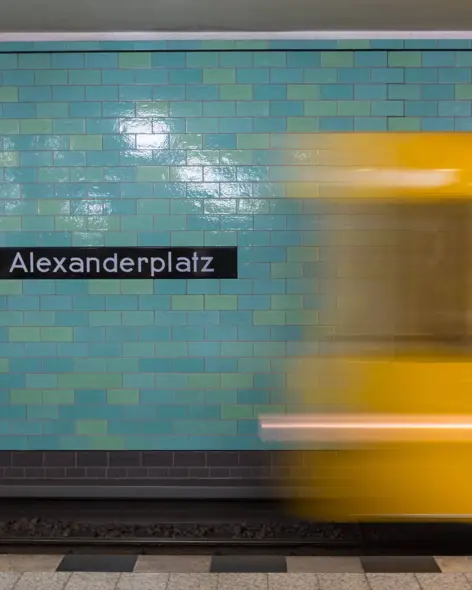
Most important transportation hub in Berlin