


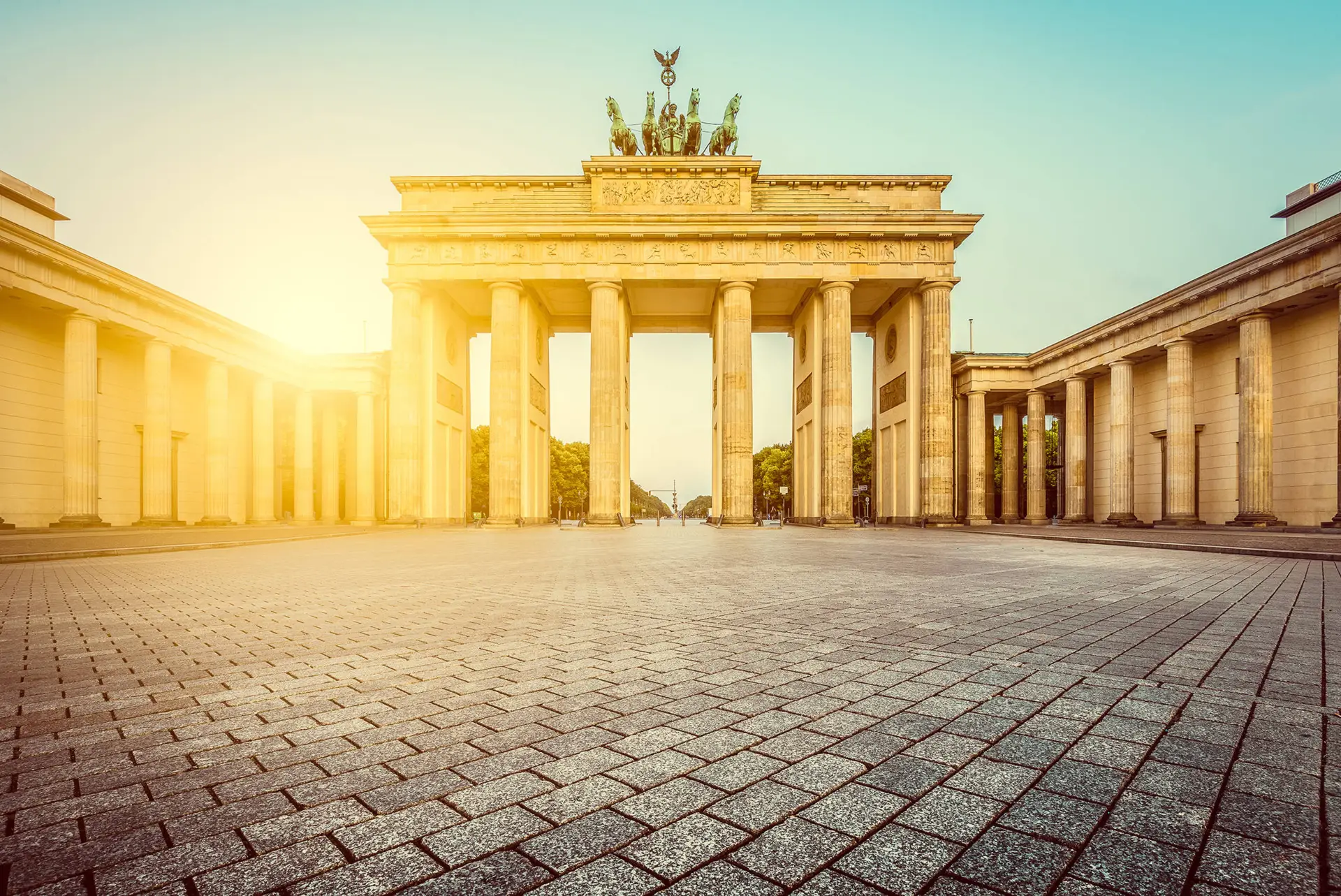
The Brandenburg Gate (Brandenburger Tor) - world-famous historical monument in Berlin
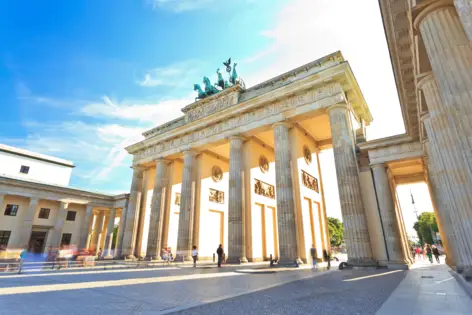
Brandenburg Gate
Thanks to the euro and cent coins, every European knows the Brandenburg Gate. Nevertheless, a visit to Berlin includes seeing it up close. The significance of this building has grown beyond its original function as a city gate. It stands for both the separation and reunification of Germany and Berlin. At the time of the Wall, it divided Berlin into East and West. The fall of the Wall at the Brandenburg Gate in December 1989 was one of the first visible signs of the city's reunification.
As a landmark of the German capital, the Brandenburg Gate is one of Berlin's most popular sights. This is also due to the monuments and historically significant sites in the immediate vicinity. These include Pariser Platz in front of the building, Straße des 17. Juni behind it, the nearby Reichstag and Unter den Linden.
In architectural terms, the Brandenburg Gate is an example of classicism and is more than 200 years old. The designs go back to the architect Carl Gotthard Langhans, who was inspired by the forecourt of the Acropolis in Athens. The imposing columns are joined by two gatehouses and the quadriga. In its original function as a city gate, it is the last remaining of Berlin's 18 city gates.
The Brandenburg Gate is easy to reach by public transport using the S-Bahn and bus. Various roads lead to and past the Brandenburg Gate. A convenient way to get here by car is to park on Straße des 17. Juni or look for a parking garage.
Book your hotel on H-Hotels.com for your stay in Berlin. We offer you the following advantages:
- Book hotels in Berlin at the best price
- Berlin hotels can be booked without a credit card
- Minibar included in all HYPERION Hotels
- Breakfast included in all H2 Hotels
City gate and end of the boulevard
A customs gate had stood on this site since the 17th century. In the 18th century, King Frederick William II wanted a more appropriate end to the boulevard Unter den Linden and modeled it on the Propylaea, the entrance gate to the Acropolis. This wish was fulfilled with the Brandenburg Gate. The sandstone structure consists of two rows of six columns, 15 meters high and framed by gatehouses.
The dignified finale of the Brandenburg Gate is the quadriga by sculptor Christoph Schadow in the middle of the building, which is no longer preserved in its original form. The Brandenburg Gate was built between 1788 and 1791 according to the designs of Carl Gotthard Langhans. It is over 20 meters high, over 60 meters wide and eleven meters deep. This made it one of the most elaborately designed city gates in Berlin at the time. Despite the monumental effect of the gate, its pictorial power took a back seat to the quadriga. At the king's request, its architect Carl Gotthard Langhans did not attend the gate's opening ceremony.
The sandstone of which it is made is susceptible to exhaust fumes. To protect the structure from damage, it has not been open to traffic since the 21st century. At the time of construction, before the division and after the reunification of Berlin, things were different. Apart from the lane in the middle, which was reserved for the Emperor until the fall of the monarchy, the Brandenburg Gate was open to all road users. Initially carriages, occasionally and later more motorists and buses passed through on five passages.
The five-metre-high Quadriga, the chariot of the goddess of victory drawn by four horses, is enthroned at the top of the Brandenburg Gate. The Quadriga only arrived at its location in 1793, two years after the opening. According to a Berlin legend, the delay was caused by the fact that the naked goddess of victory was subsequently clothed. In reality, however, work on the casting and the individual insignia of the goddess was delayed. Below the quadriga, the sandstone relief "Train of Peace" illustrates the interplay of peace and friendship with courage and bravery.
Thematically, the sculptures of Mars and Minerva in the gatehouses take up the ancient mythology of the interplay between war and peace through wisdom. The details on the columns and gatehouses depict ancient mythological legends. The reliefs on the columns and under the quadriga, for example, are images from the mythological story of the hero Hercules.
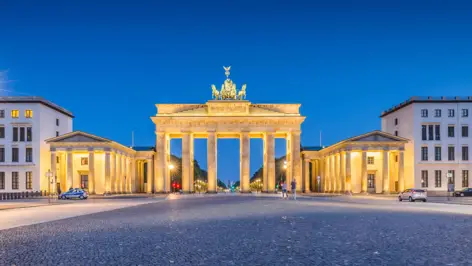
Boulevard at the Brandenburg Gate
From symbol of separation to emblem of unity
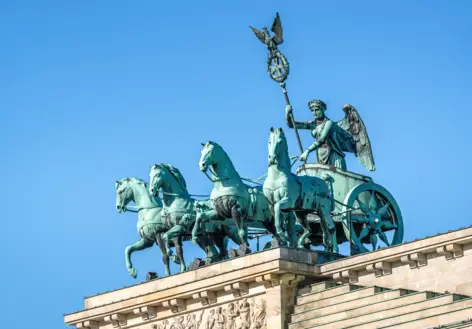
Quadriga on the Brandenburg Gate
The Quadriga is one of the components of the Brandenburg Gate with the most turbulent history. After the French conquest of Berlin, Napoleon had the goddess of victory brought to Paris in 1806. During the wars of conquest a few years later, she returned to Berlin after the victory over the French Empire in 1814. The quadriga thus developed into a symbol of victory. Karl Friedrich Schinkel placed an iron cross and an eagle next to the goddess. In Prussia, these symbols stood for bravery and success in war.
The gate and the quadriga suffered severe damage during the Second World War. The only remaining original part of the quadriga is a horse's head in the Märkisches Museum. In the late 1950s, a first attempt was made in the GDR to restore the Brandenburg Gate. The reconstructed quadriga lost its Iron Cross, because for the SED regime it was a symbol of militarism in Prussia. Before the lengthy renovation and restoration began, the city was divided by the Wall.
After the Wall was built, the area around the Brandenburg Gate became a restricted area and was no longer accessible to the public. The structure came to epitomize the division of the city into East and West, and it was here that Ronald Reagan shouted his famous sentence at the end of the 1980s that Mr. Gorbachev should tear down the Wall. The celebrations for reunification and the fall of the Wall were all the greater. These celebrations had a damaging effect on the Brandenburg Gate: after New Year's Eve in the year of reunification, the Quadriga was badly damaged and needed restoration. The goddess of victory was given back her cross and the Prussian eagle.
The room of silence
While a tourist information center has taken up residence in the southern gatehouse, the northern gatehouse houses a room of silence. With no denominational or religious orientation, this area is open to all visitors who wish to withdraw from the hustle and bustle of the Brandenburg Gate and Pariser Platz. A sign in the entrance area invites you to be silent.
After an unadorned anteroom, visitors enter the actual Room of Silence, which is kept simple and invites visitors to take a short break with seating. The Room of Silence is intended as a place of retreat that stands for tolerance and peace. The location at the symbolic Brandenburg Gate was chosen with care.
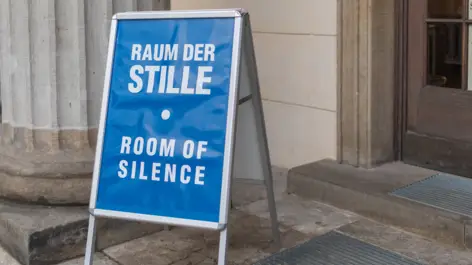
Room of silence
Germany's biggest New Year's Eve party

Fireworks at the Brandenburg Gate
As a landmark of the capital, the Brandenburg Gate is not only known for its history. In the present day, there are regular events and happenings that attract many visitors. These include the biggest New Year's Eve party in Germany. On New Year's Eve, almost a million visitors gather around the Brandenburg Gate and the Straße des 17.
They celebrate together into the New Year, accompanied by concerts and a huge fireworks display. During the soccer World Cup or the European Championship, the fan mile is located on Straße des 17. Juni, where all the games can be seen on big screens. As a symbol of the city, demonstrations regularly take place around the Brandenburg Gate.
One of the biggest demonstrations every year is the one on May 1, which ends with a party on the street behind it. One of the biggest sporting events in the world, the Berlin Marathon, also passes by here every year. In autumn, the organizers of the Festival of Lights illuminate the building in a special light. Every year on the Day of Unity, Berliners and guests gather at the Brandenburg Gate for a citizens' festival. For visitors, the Brandenburg Gate is worth seeing at any time of year and has the character of a folk festival on special dates.
From the Brandenburg Gate to Potsdamer Platz
The squares surrounding the Brandenburg Gate are also worth seeing. To the east is Pariser Platz, which is considered one of the most beautiful squares in Berlin. This is mainly due to the surrounding buildings, the Max Liebermann House, the American Embassy and the French Embassy. It was named after the wars of liberation and the victory over Napoleon.
The Max Liebermann House, the painter's former home, regularly hosts exhibitions and events. As the house was badly damaged in the Second World War, the current building is a reconstruction. Pariser Platz is the ideal place to take the perfect photo of the front of the Brandenburg Gate with its quadriga. As the gate is one of Berlin's most popular sights, it is rarely deserted.
Further east, the Hotel Adlon borders Pariser Platz, one of Germany's most famous and luxurious hotels. Straight ahead, the street Unter den Linden leads past Madame Tussauds towards Museum Island and Alexanderplatz. About one kilometer away is the Gendarmenmarkt. It surpasses Pariser Platz in terms of architectural beauty with the German Cathedral, the Concert Hall and the French Cathedral. If you walk through the opening and columns, you can see the Victory Column in the distance.
The Straße des 17. Juni leads through the Tiergarten past the Soviet Monument of Honor with its tank to the Goldelse, a colloquial name for the Victory Column. The Platz des 18. März is located directly behind the Brandenburg Gate. Its name commemorates two important historical events that took place on March 18: the March Revolution in 1848 and the first free Volkskammer elections in the GDR in 1990.
If you keep to the left, you will pass the Memorial to the Murdered Jews of Europe and the Ministerial Gardens and reach Potsdamer Platz in ten minutes. The concrete steles of the Holocaust memorial are a powerful reminder of the Jewish victims. The modern Potsdamer Platz, consisting of glass skyscrapers, forms an antithesis to the historical Berlin characterized by classicism. The dome of the Reichstag building can be seen on the right. A short walk takes you to the Reichstag and the government district with the Federal Chancellery.
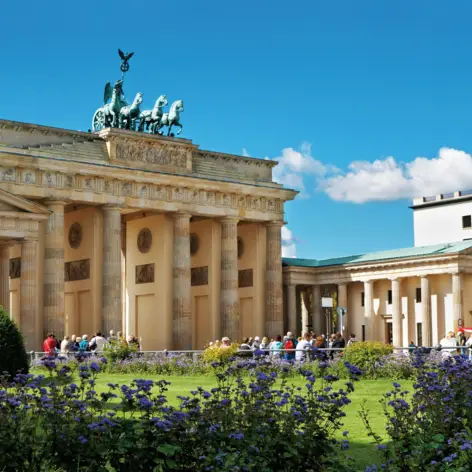
Pariser Platz