


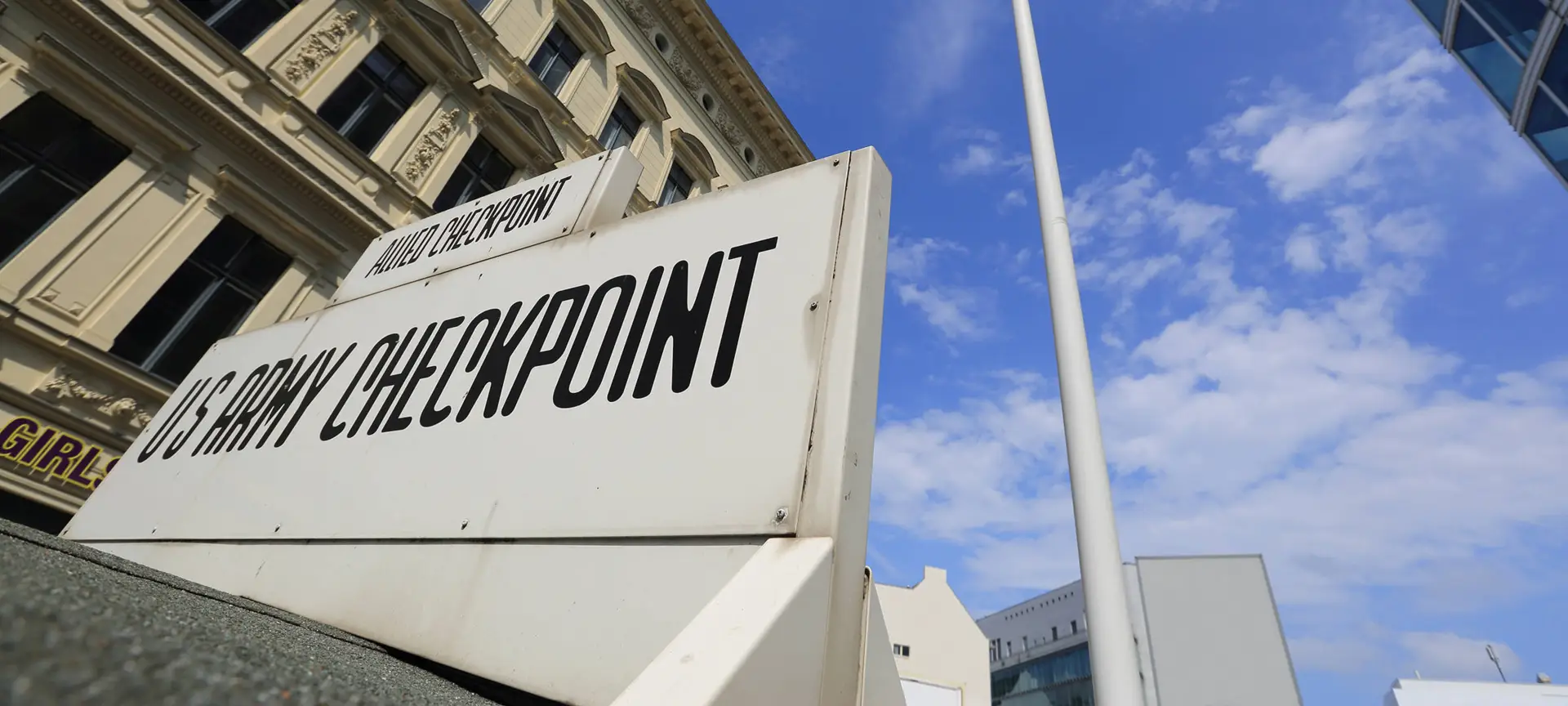
Checkpoint Charlie - Berlin's most famous border crossing
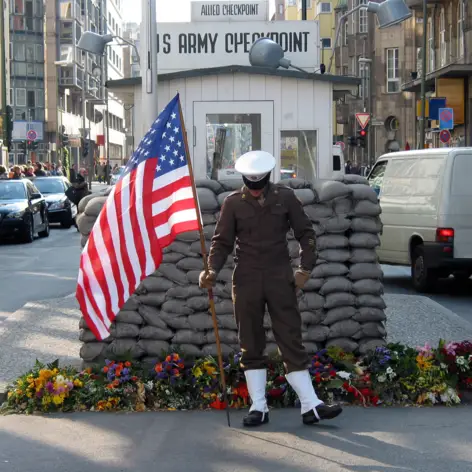
Checkpoint Charlie
Checkpoint Charlie is a former border crossing between East and West Berlin on Friedrichstraße. This place is one of the most exciting sights for many visitors to Berlin.
Checkpoint Charlie is a symbol of the division of Berlin into East and West by the Wall. However, there is not much left to see of the original site. The original barriers and watchtowers that secured the border have disappeared, as has the Wall. Nevertheless, this site is one of the most visited in Berlin.
The former checkpoint has been reconstructed on the corner of Friedrichstraße and Zimmerstraße. Visitors can get an impression of what it looked like during the Cold War, complete with control barracks, flags and sandbags. Actors dressed as American soldiers stand ready for photos at the reconstructed props.
Checkpoint Charlie appears as a location in many films and novels, one of the most famous being James Bond's "Octopussy". The movie shows the original location. The border crossing was only open to foreigners, allies and diplomats, providing material for spy stories. Normal GDR or FRG citizens used other official border crossings to reach the other part of the city. At the time, the GDR regime used the term border crossing to present itself as a state. The American, British and French Allies stuck to the word checkpoint.
Checkpoint Charlie owes its name to the international spelling alphabet: The Allied checkpoints on the inner-German border were numbered according to this and there was Alpha, Bravo and Charlie. The largest crossing point was located between the municipalities of Helmstedt and Marienborn and was therefore designated Alpha. The border crossing on the Dreilinden-Drewitz highway was called Bravo. The crossing in the center of Berlin on Friedrichstraße was given the name Charlie according to the order.
The reconstructed checkpoint is designed for media impact and is particularly popular with tourists. In the immediate vicinity of Checkpoint Charlie, museums provide information about the division of Berlin and the Cold War. The Wall Museum provides information about escape attempts and the effects of the Wall on the population, while the Asisi Panorama recreates an autumn day in 1980. Nearby is the Trabi Museum and the neighboring rental shop offers Trabi tours along the course of the Wall.
The easiest way to reach Checkpoint Charlie is by public transport, with the Kochstraße subway station right next to it. If you want to pass the checkpoint by car, you will need patience. Friedrichstraße is one of the main thoroughfares in Berlin's city center and tourists and passers-by are also looking for their way.

Book your hotel on H-Hotels.com for your stay in Berlin. We offer you the following advantages:
- Book hotels in Berlin at the best price
- Berlin hotels can be booked without a credit card
- Minibar included in all HYPERION Hotels
- Breakfast included in all H2 Hotels
Symbol of the division of Berlin and the Cold War
After the end of the Second World War, the victorious Allied powers divided Berlin into four sectors. As the Cold War approached, Berlin became a focal point and the construction of the Wall cemented the division of the city into East and West. As a border checkpoint, Checkpoint Charlie is one of the most important border points for international politics, alongside the Glienicke Bridge.
Only foreigners, members of the Permanent Representation of the FRG in the GDR and GDR officials were allowed to pass through here. The situation at Checkpoint Charlie threatened to escalate when Soviet and American tanks with live ammunition moved into position in 1961.
The reason for this was the demand by GDR border guards that members of the US mission had to identify themselves. From the American perspective, this identification requirement would have meant legitimizing the GDR. What could have ended in an escalation between the USA and the Soviet Union in the middle of Berlin was resolved by diplomats. The tanks withdrew after one night.
Checkpoint Charlie also became sadly famous for the fatal escapes of GDR citizens. The woman from Checkpoint Charlie, Jutta Fleck, also demonstrated here for months for permission for her children to leave the country. Even though Checkpoint Charlie is sometimes regarded as an open-air museum, it is important to remember that the site has very little of the original location.
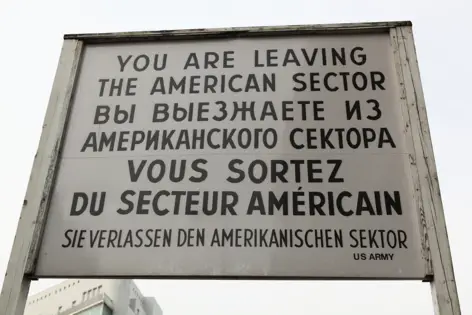
Signs and large photographs of American and Soviet soldiers today make it clear when tourists enter or leave the original American sector. Checkpoint Charlie was dismantled even before the official reunification of Germany. Its original components, including the control barracks, can be found in the Allied Museum in the Steglitz-Zehlendorf district.
The house at Checkpoint Charlie

House at Checkpoint Charlie
The Haus am Checkpoint Charlie is one of the first Wall museums. It is located directly at the former border crossing in Friedrichstraße. Dr. Rainer Hildebrandt founded it in 1961 and collected documents and objects from GDR refugees. In addition to the documentation, Hildebrandt and museum staff supported escape helpers and journalists. What was initially a documentation center in his own apartment developed into a museum, which has been located in the house at Checkpoint Charlie since 1963. At the time, the house was considered the last building before the border.
Visitors can discover the history of the Wall with a focus on the experiences of GDR citizens who fled. The museum's most unusual exhibits include objects that GDR citizens used to escape, such as a mini submarine, chair lifts and hot air balloons. In addition to the stories about the Wall, permanent exhibitions on peace, human rights and freedom complement the information on offer. These look beyond Berlin and Germany and focus on peace missions in Asia and Africa.
BlackBox Cold War
On the corner of Zimmerstraße, the BlackBox Cold War and the Checkpoint Charlie Gallery provide further information on the history of the border crossing. The focus is on the significance of Berlin and Germany during the Cold War. Visitors can also learn more about Berlin's special position as a divided city and the direct scene of the confrontation between the blocs. A gallery with photos, media stations and exhibits brings history to life from an international perspective.
The East-West confrontation did not only take place in Berlin and the exhibition also shows the other sites of the Cold War throughout the world. This includes the symbolic architecture of the pavilion, which sees itself as a black box, a flight recorder of history. The red column stands for the Soviet Union, while the blue windows represent the USA.
175 photos with bilingual commentaries illustrate the history. These show successful escapes and failed escape attempts such as that of 18-year-old Peter Fechter, who bled to death in the border strip. The BlackBox Cold War is considered a temporary solution. Due to the high number of visitors to the checkpoint, the question of an appropriate museum arose early on.
The area on which the BlackBox stands is intended for this purpose. Until this is created, the BlackBox and the gallery offer a varied, media-based open-air exhibition. For tourists interested in other memorials to the Berlin Wall and the Cold War, a map provides an overview of other museums and sites.
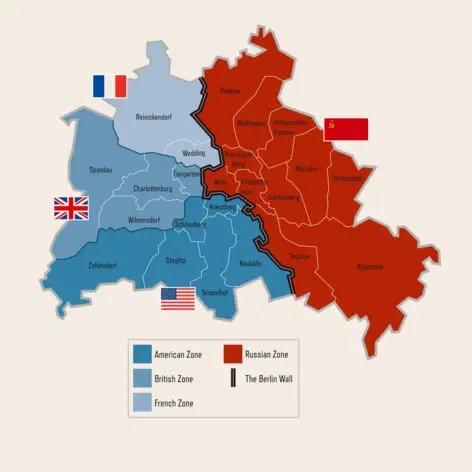
Division of Berlin by the Allies (1961)
The Asisi Panorama
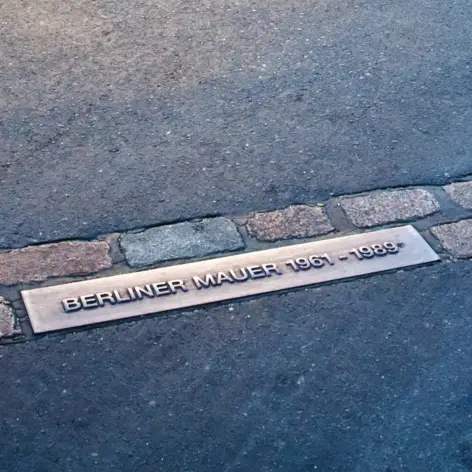
Berlin Wall 1961- 1989
Opposite the BlackBox is the panorama "The Wall" by artist Yadegar Asisi. He lived in Kreuzberg for some time after the Wall was built in divided Berlin and processed his impressions in this panorama. The highlight of this place is a panorama installation that shows the Wall on a normal fall day. The circular picture is 15 meters high, can be viewed from a visitor platform and is 60 meters long. The scene of the picture is the Berlin Wall in Kreuzberg near Moritzplatz and Oranienplatz.
It depicts life at the Berlin Wall with the death strip and normal everyday life.
The seemingly normal image of a city illustrates the absurdity of division, which was part of normality for many residents. Meanwhile, tape recordings of famous statements and speeches by politicians such as John F. Kennedy and Walter Ulbricht are played in the background. An exhibition with photos of contemporary witnesses adds to the impression of how Berlin's residents and visitors experienced the divided city. The panorama has been in place since 2012 and was originally planned to run for one year. Due to demand, it will remain open until the area on which it stands can be freed up for other construction projects.
Looking down on the checkpoint from a captive balloon
The HiFlyer tethered balloon in Zimmerstraße offers the opportunity to discover Checkpoint Charlie and the area from above. The balloon remains connected to the ground the entire time by a steel cable and rises to a height of 150 meters.
Those interested in technology and the history of transportation will find the Trabi Museum near the checkpoint in Zimmerstraße. There you will find information and exhibits about the GDR's most famous vehicle, the Trabi. A wide variety of models tell the story of this "racing car". The adjoining cinema sheds light on the development and significance of the Trabant in everyday life in the GDR in an entertaining way.
Right next to the museum, the Trabi World car rental service offers license holders the opportunity to drive a Trabi. A Trabi safari with a guide takes you to Berlin's sights and along the course of the Wall.
A unique museum awaits in Schützenstraße, just a few minutes' walk from Checkpoint Charlie: the German Currywurst Museum. The museum is designed as an adventure museum and offers special activities for children. But adults can also find out everything they need to know about currywurst, which originated in Berlin.
A five-minute walk from Checkpoint Charlie, the Museum of Communication on Leipziger Strasse combines knowledge and entertainment with multimedia exhibitions. Ten minutes' walk from the checkpoint is the largest Jewish museum in Europe. It is located on Lindenstraße and is highly recommended for its architecture and acclaimed exhibitions.
If you continue along Friedrichstraße towards the city center from Checkpoint Charlie, you will reach Mitte from Kreuzberg. Tourists and Berliners stroll past exclusive stores and the Galeries Lafayette. The Gendarmenmarkt is also just a ten-minute walk away.
If you would like more information about the divided Berlin, you will find the Berlin Wall Memorial in Niederkirchner Straße. The fragments of the Wall in Niederkirchner Straße are a listed monument and are part of the "Topography of Terror" exhibition, which is dedicated to National Socialism.

Captive balloon at Checkpoint Charlie