


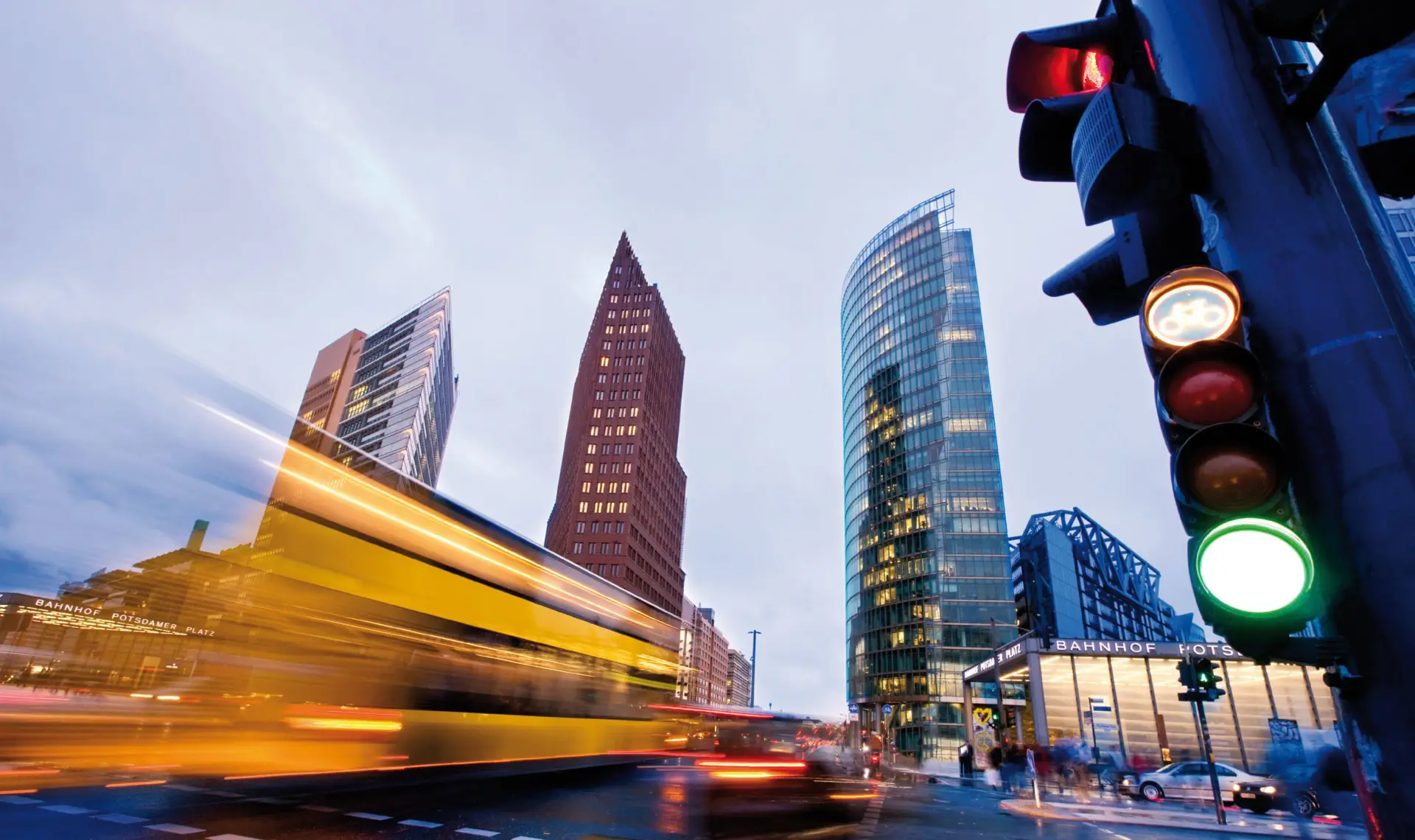
Potsdamer Platz - center for entertainment and culture in Berlin
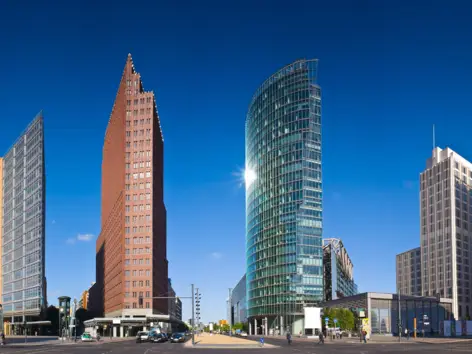
Potsdamer Platz
Potsdamer Platz is the epitome of modern Berlin. From a wasteland created by the division of Berlin, the area has developed into a center of modern architecture.
The entire area of the square and the buildings around it were designed by architects and combine business with entertainment and culture. The Deutsche Bahn Tower and the tent roof of the Sony Center are symbols of the square's high-rise architecture. The term Potsdamer Platz has grown beyond the one square and is used by many Berliners to describe the entire quarter and the adjacent streets.
The Potsdamer Platz Arkaden and the Sony Center invite you to stroll around during the day. Museums, the panorama point in the Kollhoff Tower and various cafés and restaurants are destinations for tourists, guests and Berliners alike. Theaters, cinemas, bars and a casino also make Potsdamer Platz an attraction after hours.
Potsdamer Strasse is an important traffic junction between Berlin-Mitte and Tiergarten. The construction of a streetcar line is being planned. S-Bahn, U-Bahn and various bus lines run here. The subway and S-Bahn tracks run underground. There is a central passageway above the S-Bahn station. The central arcade connects the S-Bahn a few meters with the Potsdamer Platz Arkaden and offers additional stores.
Book your hotel on H-Hotels.com for your stay in Berlin. We offer you the following advantages:
- Book hotels in Berlin at the best price
- Berlin hotels can be booked without a credit card
- Minibar included in all HYPERION Hotels
- Breakfast included in all H2 Hotels
From traffic junction to Europe's largest construction site
The proximity of Potsdamer Platz to Tiergarten made it an attractive residential area in the 19th century. Known at the time as the square in front of the Potsdamer Tor, it was a junction for the connection from Berlin to Potsdam. In 1924, Germany's first traffic lights went into operation here, regulating the flow of buses, streetcars and cars. It can still be seen on the open space today and is now out of service.
Theaters, cinemas and restaurants made the area a popular nightlife destination in the capital. Many buildings were destroyed after the Second World War, but it was the division of Berlin that caused the area to lose its importance. The widest section of the death strip along the Wall ran here. The traces of the Wall have disappeared. But if you look down at Potsdamer Platz, you will see a metal strip on the ground that traces the course of the Wall.
With the fall of the Wall, the plan to rebuild the area as an urban quarter began with a large construction site in the 1990s. Architects such as Renzo Piano gave the square a modern 21st century look. Traces of the old Potsdamer Platz can still be found in the Sony Center. The historic façade of the Hotel Esplanade is integrated into it.

Aerial view of the Potsdamer Platz transportation hub
Shopping arcades, nightlife and oases of peace

Sony Center
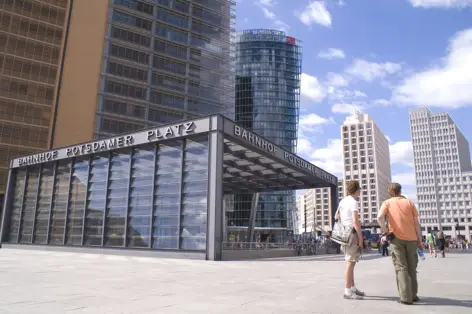
The Potsdamer Platz ensemble, which is easily accessible via the train station of the same name, includes office buildings, hotels, restaurants and cafés. The Potsdamer Platz Arkaden is a shopping center with various stores and the Sony Center also has stores and restaurants as well as a Sony branch.
Just a few minutes' walk away on Leipziger Platz is the Mall of Berlin, one of the largest shopping centers in the city. One of the most successful shows in Berlin has taken up residence here: The Blue Man Group entertains audiences at the Bluemax Theater. Not far away is the Spielbank Berlin casino.
Tilla-Durieux-Park and Henriette-Herz-Park have developed as green retreats in Linkstraße. The green hills symbolize the path from east to west. Ducks, fish and reeds in the middle of the city can be found at the Piano Lake. Haus Huth is the only historic building on Potsdamer Platz. Built in 1912, the building now houses free exhibitions of modern art.
Deutsche Kinematik, the Museum for Film and Television, is dedicated to a different form of art. The Boulevard of Stars also takes up the theme of film and television.
German actors have been given their own star in the middle of Potsdamer Strasse. The Panoramapunkt offers a special view of Potsdamer Platz and Berlin. It is located on the 24th floor of the Kollhoff Tower and visitors can reach the viewing platform using the fastest elevator in Europe.
A contrast to the glass skyscrapers is the stone Beisheim Center next to the Sony Center. The Beisheim Center is an ensemble of buildings with hotels, offices and stores. It is home to The Ritz-Carlton Hotel and the Berlin Marriott Hotel. Other impressive buildings include the twin towers on Linkstrasse, which were designed by architect Richard Rogers.
If you are at Potsdamer Platz with children, a visit to the Legoland Discovery Center is well worthwhile. As an indoor Legoland, it is also an attraction in bad weather.
Berlinale, Christmas market and festival of lights

Christmas at Potsdamer Platz
Potsdamer Platz is now known worldwide as the place where filmmakers meet every year in February. The Berlin Film Festival, or Berlinale for short, has various locations. Guests have the opportunity to watch the more than 400 films in the competition in various cinemas across the city. But the stars and award ceremony are at Potsdamer Platz in the Stage Theater. This is located on Marlene-Dietrich-Platz and shows musicals and shows on other days.
A Christmas market is held directly on Potsdamer Platz and in Alte Potsdamer Straße at Christmas. While the trees and stalls hung with fairy lights on Alte Potsdamer Straße invite you to stroll around, the winter wonderland on the square is a hive of activity. This includes an ice skating rink and one of the largest toboggan runs in Europe.
In the fall, Potsdamer Platz is the stage for Berlin's Festival of Lights. From here you can walk to other illuminated buildings such as the Brandenburg Gate or the Victory Column.
Around Potsdamer Platz
As an urban center, Potsdamer Platz impresses with its skyscrapers. Its central location makes it an ideal starting point for discovering other sights in the capital.
Nearby is the Memorial to the Murdered Jews of Europe, the Tiergarten park and the Brandenburg Gate. Leipziger Platz is home to the Spy Museum and a Dalí exhibition.
Ten minutes' walk down Stresemannstraße is the Martin-Gropius-Bau, which regularly hosts changing exhibitions on art, history and photography.
On the way to the Holocaust Memorial and the Brandenburg Gate is the Otto Bock Science Center on Ebertstraße. One of the most important cultural centers near Potsdamer Platz is the Kulturforum. Here you will find the Neue Nationalgalerie, the Gemäldegalerie, the Kunstgewerbemuseum and the Philharmonie. In Erna-Berger-Straße, a side street of Stresemannstraße, you can visit one of the last GDR watchtowers as a witness to the division of Germany.
The Großer Tiergarten, the largest park in the capital, provides peace and relaxation. Where the tracks of the railroads once ran along, there is now the Park am Gleisdreieck near Potsdamer Platz.
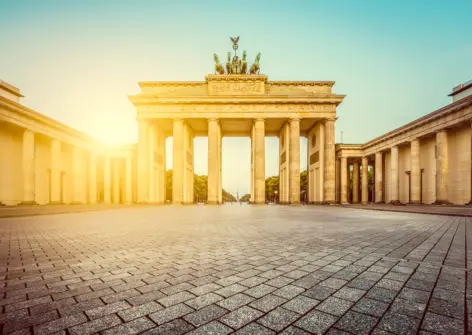
Brandenburg Gate