


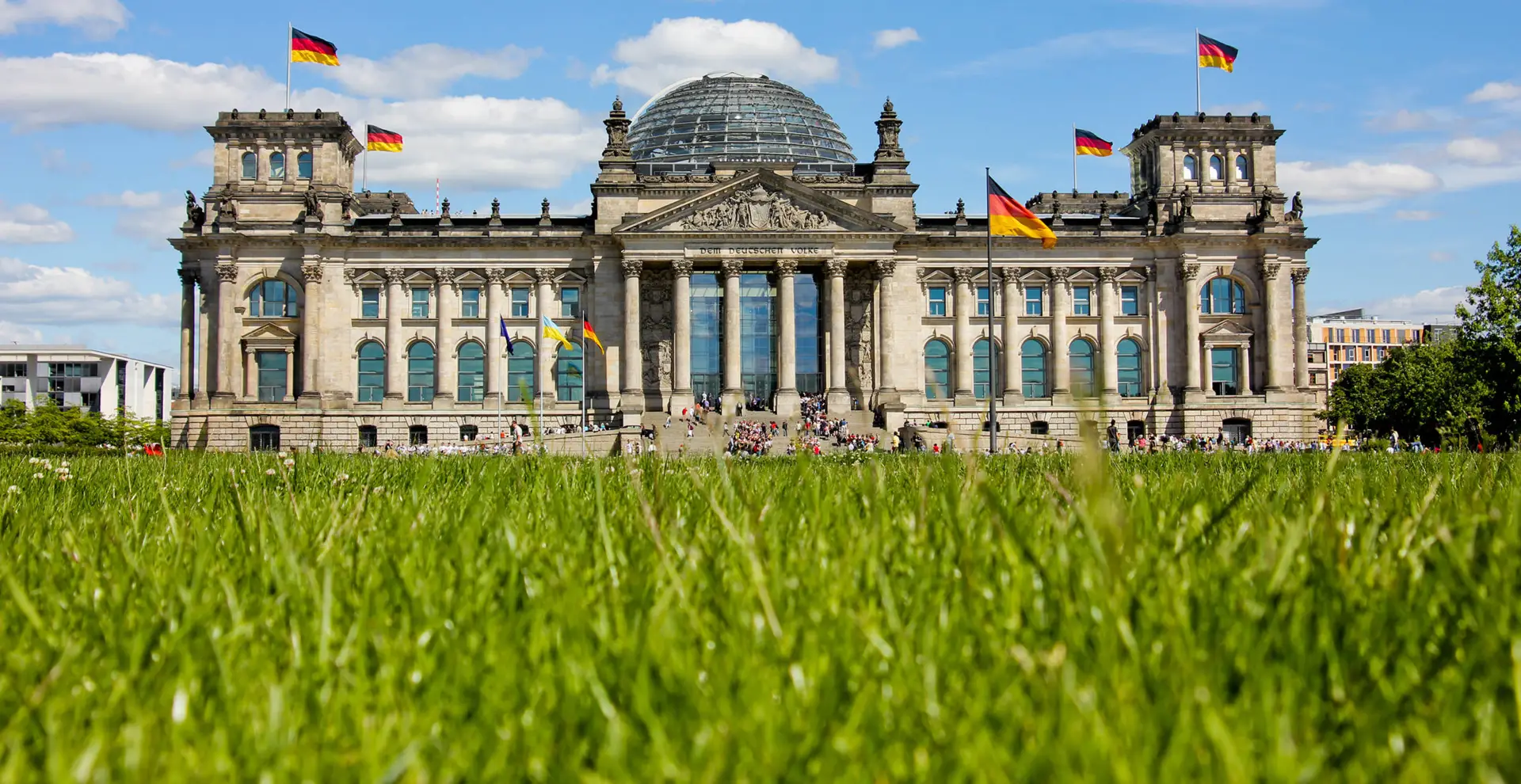
The Reichstag - the center of German politics in Berlin

Reichstag
The most visited attraction in the capital is the Reichstag. Known as the Reichstag for short, its official name is the Reichstag Building or the Reichstag Plenary Building.
As the seat of the Bundestag, it is the center of German politics and the glass dome is a symbol of Berlin and the German federal government. The dome, the roof terrace or a visit to a plenary session are open to visitors free of charge by appointment. The dome offers a panoramic view over Berlin, while attending a plenary session in the visitor area shows the parliament and the MPs at work. Registration is required for security reasons.
As the Reichstag is one of the most popular sights in Berlin, it is well worth visiting on a weekday. Especially at weekends, it is a destination for Berliners and tourists alike and the waiting times for a free time slot are correspondingly long. The Reichstag building was designed by architect Paul Wallot and, as a historicist building, combines elements from the Renaissance, Baroque and Classicism periods. In the center of Berlin, the Reichstag can be reached by bus and train. The buses stop directly at the Reichstag, while the route from the Hauptbahnhof S-Bahn station takes you past other government buildings.
Book your hotel on H-Hotels.com for your stay in Berlin. We offer you the following advantages:
- Book hotels in Berlin at the best price
- Berlin hotels can be booked without a credit card
- Minibar included in all HYPERION Hotels
- Breakfast included in all H2 Hotels
The history of the Reichstag
The Reichstag looks back on a long history that shaped Germany. This includes, for example, Philipp Scheidemann's speech to the people and the Reichstag fire, which was never fully resolved. The Reichstag building was built at the end of the 19th century according to the plans of architect Paul Wallot. Berlin had been the capital of the Reich since 1871 and needed a representative seat of government that offered sufficient space for the growing number of members of parliament. The foundation stone for the building was laid in 1884 and it was completed ten years later.
The Reichstag building was an example of German engineering and, with its own power station and telephones, was at the cutting edge of technology. The original building underwent numerous changes. The original inscription "To the German people" has been preserved. The phrase "to the German people" was suspect to the parliament and the emperor. The inscription was not added to the west portal until the First World War in 1917.
Philipp Scheidemann proclaimed the Weimar Republic from a balcony of the Reichstag on November 9, 1918. The Reichstag fire in February 1933 ushered in the National Socialist takeover.

Drawing of the Reichstag

At the end of the Second World War, the red flag of the Soviet Union flew here, symbolizing the victory of the Allies over Nazi Germany. Soviet soldiers had hoisted it and left further traces on the building. The Second World War caused severe damage to the Reichstag building and it was rebuilt in the 1950s.
During the years of German division, the Reichstag was located in West Berlin and was used for parliamentary sessions, events and public exhibitions. Shortly after reunification, the decision was made here that Berlin would once again be the capital of Germany. In order to provide the Bundestag and the seat of government with an appropriate building, a conversion and reconstruction was necessary.
The architect Sir Norman Foster won the competition and gave the building its current appearance. The conversion for the Bundestag combines the modern glass dome and the classical style. The building has been the seat of the German Bundestag since 1999.
The glass dome of the Reichstag
The dome and a dome walkway are the highlight of a visit to the Reichstag building. It is 23 meters high and 40 meters wide. Flooded with light, it is made of steel and glass and was designed by Sir Norman Foster. It is accessible to visitors via the roof terrace. At a height of 24 meters, the Käfer restaurant on the roof terrace of the Reichstag offers a unique view. Spiral ramps lead up and down to the viewing platform in the dome.
This is located at a height of 40 meters and its function is not only representative: mirrors provide natural lighting and ventilation in the plenary chamber. A total of 360 individual mirrors reflect the sunlight and can be shaded by a sun protection element. At a height of 47 meters, the dome is lower than the original stone dome designed by Paul Wallot. However, this does not affect the view of the Brandenburg Gate, the Spree and the government district.
The fact that the plenary chamber and the members of parliament are visible underneath the dome can be seen as a symbol of transparent democracy. Apart from visiting the dome, visitors can book tours and guided tours. The tours take visitors through the Reichstag, its works of art and show graffiti left behind by Soviet soldiers. It is also possible, by appointment, to take a seat in the visitors' gallery in the plenary chamber and follow the discussions in parliament.

Glass dome
The Reichstag and the government district

Even outside the Reichstag, the building offers interesting details that are reminiscent of German history. A piece of wall from the Gdansk shipyard on the north side commemorates the importance of the Polish trade unions for reunification. In the north-east is a memorial plaque commemorating Hungary's opening of the border. Directly in front of the Reichstag is the Platz der Republik.
As a large open space with a lawn, it invites you to linger, provided it is not the site of a meeting or demonstration. To the north and south of the Reichstag, there are white crosses on the Spree and in the Tiergarten. They commemorate those who died at the Wall. In Tiergarten on Scheidemannstraße is the memorial to the murdered Sinti and Roma. In the middle of the area surrounded by glass panels is a fountain with a single flower. If you continue along Scheidemannstraße, you will come to John-Foster-Dulles-Allee and the House of World Cultures and the Carillon. The carillon sounds every Sunday.
The avenue ends at Bellevue Palace. Bus route 100 stops at the Reichstag, passing Bellevue Palace, the Victory Column and ending at the Zoological Garden. To the south-east of the Reichstag, the sights of the Brandenburg Gate and Pariser Platz are just a few minutes' walk away.
In the adjacent government district, the Chancellery, the Paul Löbe House and the Marie-Elisabeth Lüders House form the ribbon of the federal government. They are arranged across the Spree from east to west and symbolize reunification. The modern architecture of the buildings forms a contrast to the classical-looking Reichstag.
The Federal Chancellery is considered the largest government headquarters in the world and is the Chancellor's office. Visitors have the opportunity to take a look inside the Federal Chancellery on an annual open day. The offices of the members of parliament are located in the Paul Löbe House. The Marie-Elisabeth-Lüders-Haus is home to the specialist scientific services for the Bundestag and Parliament. Worth seeing is the glass bridge that connects the two buildings and is nicknamed the "Leap over the Spree".

Paul Löbe House (right)