


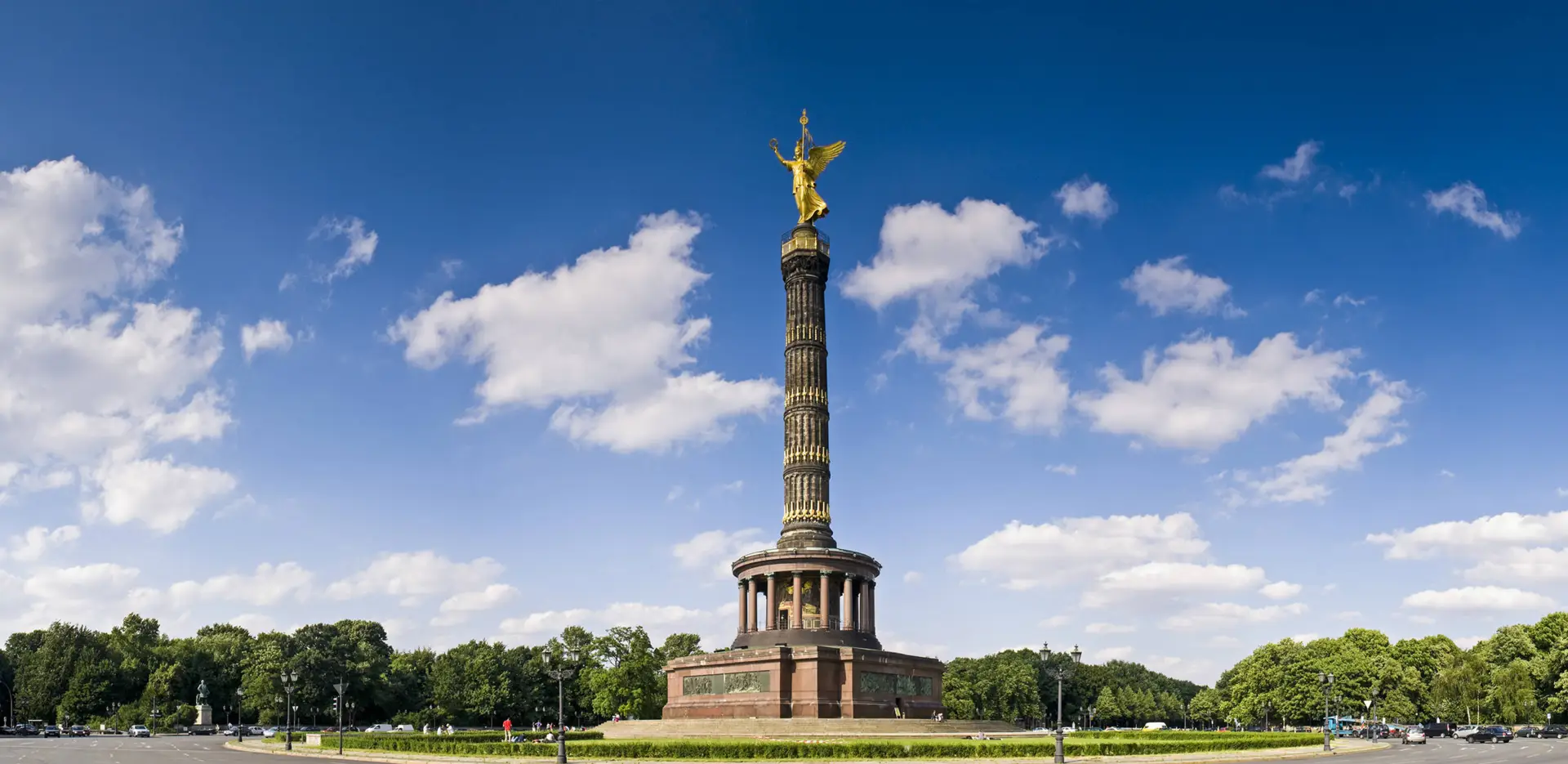
The Victory Column (Siegessäule) - a landmark with a charming view over Berlin.
The Victory Column stands over 60 meters high in the middle of the Tiergarten in Berlin-Mitte. The golden bronze sculpture of the Roman goddess of victory, Victoria, towers high above it, visible from afar.
Because of her golden appearance, Berliners unconcernedly call her Goldelse. Surrounded by a large traffic circle, the Großer Stern, the monument can be reached by pedestrian tunnels. The entrances to the tunnel cannot be overlooked due to the neoclassical-style gatehouses. In the tunnels, the light installation "Mnemosyne" picks up on the movements of passers-by.

Book your hotel on H-Hotels.com for your stay in Berlin. We offer you the following advantages:
- Book hotels in Berlin at the best price
- Berlin hotels can be booked without a credit card
- Minibar included in all HYPERION Hotels
- Breakfast included in all H2 Hotels
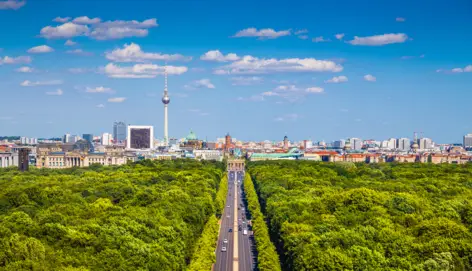
View from the Victory Column
An installation at the intersections of the tunnels gives an impression of how the Victory Column was portrayed in films. An exhibition in the base of the column tells the story of the Victory Column and is dedicated to comparable buildings. The viewing platform offers a view of Berlin across the Tiergarten.
The Victory Column stands in the middle of Straße des 17. Juni and serves as the starting and finishing point or backdrop for many events. In 2008, Barack Obama spoke here as a presidential candidate in front of 200,000 people and the Love Parade took place here in the 1990s. It is a 20-minute walk from the Brandenburg Gate to the Victory Column. The Bellevue S-Bahn station is close to the historic landmark, while the number 100 bus stops directly at the Grosser Stern.
From a symbol of victory to the capital's landmark
The Victory Column was built between 1865 and 1873 to celebrate the victory of Prussia and its ally Austria in the war against Denmark in 1864, followed by victories over Austria and France in the course of the unification wars. These wars are known as the Wars of Unification as they led to the founding of the German Empire. The column was designed by the architect Johann Heinrich Strack.
The base is made of red granite and the column drums are made of sandstone. The design thematizes the wars and victories. In the portico, a mosaic by Anton von Werner tells of the victory against France and four bronze reliefs on the plinth tell of the other wars and the founding of the Reich.
The glorification of these victories and the wars fought culminates in the eight-metre-high goddess of victory, Victoria, at the top of the column. Her appearance goes back to the sculptor Friedrich Drake. The bronze sculpture weighs 35 tons. In her right hand, the golden elf holds a gilded laurel wreath. The laurel wreath is a classic symbol of victory and honor. The spear with the Iron Cross in the Goldelse's left hand are Prussia's symbols of honor and distinction in war.

Golden Else

Reichstag today
In imperial times, the Victory Column was a national monument. It originally stood on today's Platz der Republik in front of the Reichstag, which did not yet exist, at least in the early years of the Victory Column. During the National Socialist era, Berlin was redesigned. The plan was to create a representative imperial capital "Germania" and in the course of this, the Victory Column was moved to its current location.
The column was also given a fourth column drum. This differs from the first in that it lacks the gun barrels. Instead, it is decorated with gilded garlands. The Victory Column is one of the few landmarks in the city that did not suffer any serious damage during the Second World War. As a symbol of nationalism, the French Allies wanted the column demolished after the liberation of Berlin. As it had been built before the First World War, it was protected by the other Allies.
Panoramic view after 285 steps
The artistic reliefs on the base, the glass mosaic and the exhibition in the base building complement the highlight of the Victory Column: the viewing platform at a height of 51 meters. A spiral staircase with 285 steps leads up to the platform. It offers a view of the green Tiergarten park, the Straße des 17. Juni, the Brandenburg Gate, the Reichstag and Bellevue Palace.
The view extends from Berlin's historic center to modern Berlin. You can see the government district, the main railway station, Potsdamer Platz with its glass skyscrapers and Ernst-Reuter-Platz.
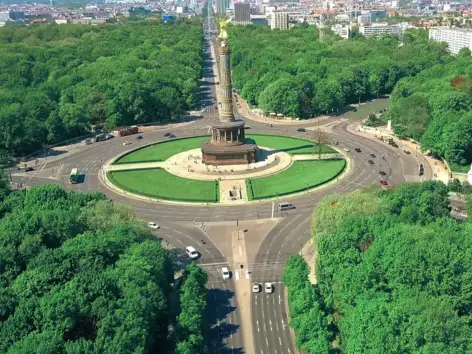
On a clear day, other sights such as the radio tower and Teufelsberg can be seen to the west. To the south are the zoo and the Memorial Church. The Goddess of Victory is enthroned directly above the viewing platform and offers the opportunity to take a closer look. Only from above does a perspective open up to take in the layout of the Great Star.
Five main roads lead off the four-lane traffic circle. Created in the 17th century on a clearing in the forest, the Grosser Stern is now an important traffic junction. The square, in the center of which the column is located, is framed by three monuments.
Big star

Bismarck National Monument
You can discover the monument to Otto von Bismarck, Albrecht von Roon and Helmuth Karl Bernhard von Moltke. The Bismarck National Monument was created by the artist Reinhold Begas and is in the neo-baroque style. It shows the Imperial Chancellor in a tunic, accompanied by symbolic figures for strength and state wisdom. Not everyone is familiar with Albrecht von Roon and Bernhard von Moltke. Both were military men, one a war minister, the other a leading figure in the wars of unification.
The ascent to the Victory Column via the narrow spiral staircase is worthwhile for visitors who are in good physical condition and not afraid of heights. Due to the age of the column, there is no elevator or other barrier-free access to the platform.
From the Victory Column to Bellevue Palace
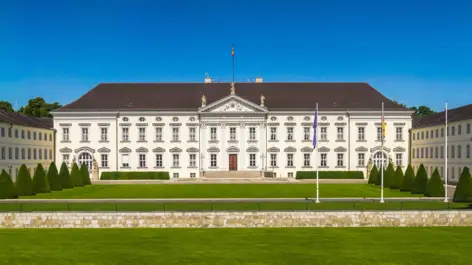
Berlin's largest park, the Tiergarten, is located in the immediate vicinity of the Victory Column. Open spaces, ponds and small woods in the park are ideal for a short break from the big city. The Spreeweg leads along the Tiergarten from the Victory Column to Bellevue Palace. The palace was built in the 18th century.
Today's building is a reconstruction from the 1960s and serves as the residence of the Federal President. You can tell whether he is at home by the hoisted standard. The palace owes its name "Bellevue" to the beautiful view of the surrounding parkland.

Federal Chancellery
From there, the Reichstag and the government district are a 20-minute walk past the Haus der Kulturen der Welt and along the Tiergarten.
If you walk down Hofjägerallee, you will come to the Nordic embassies, which are well worth seeing for their architecture. The embassy buildings of Denmark, Finland, Iceland, Norway and Sweden are designed as an ensemble and coordinated with each other. They are not open to visitors. However, it is worth visiting the Felleshus, the cultural center of the Nordic embassies. It regularly hosts events and exhibitions. The canteen and coffee bar are ideal for a lunch break with Nordic specialties and a view of the embassies.