


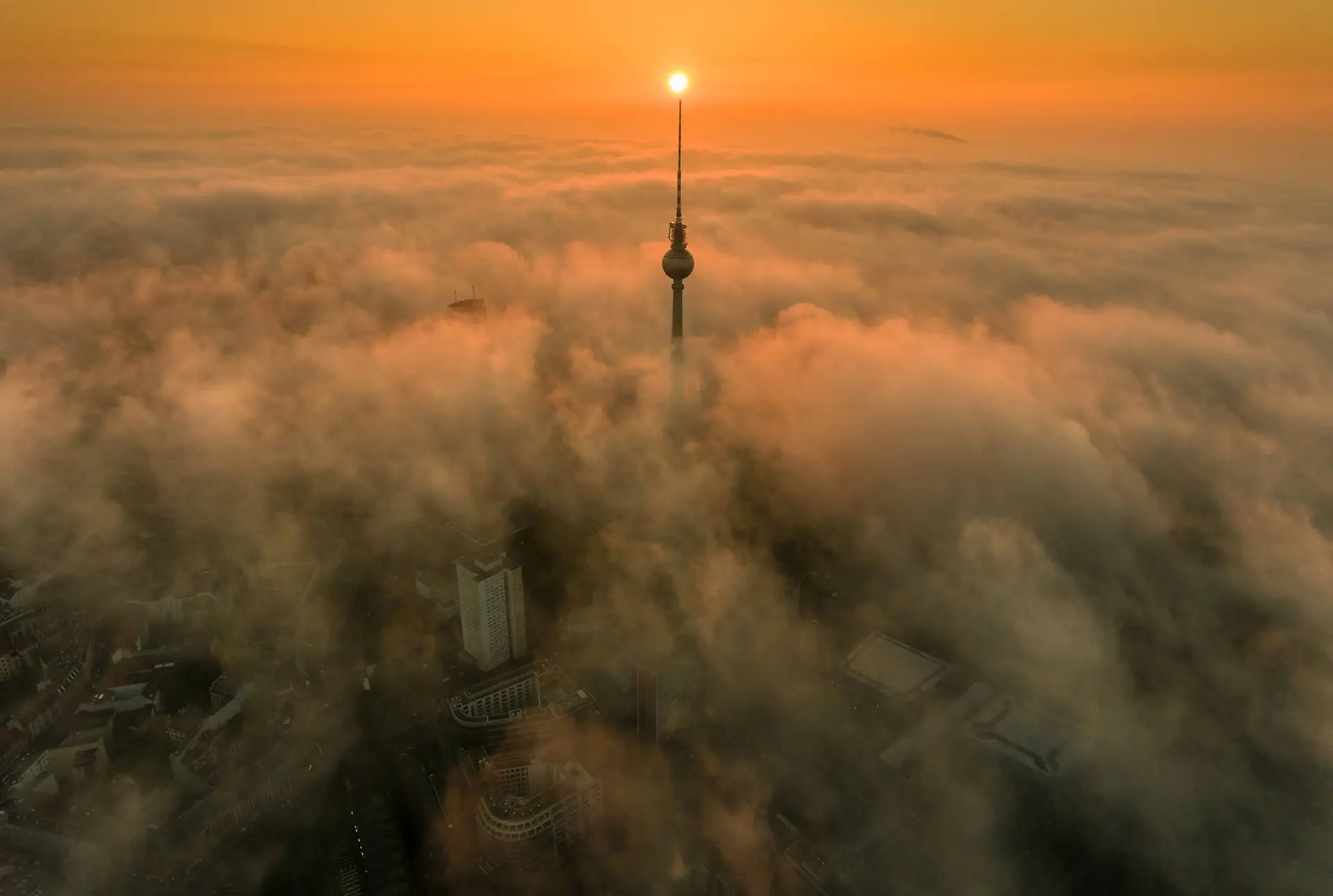
The TV Tower (Fernsehturm) - Berlin's number one landmark.
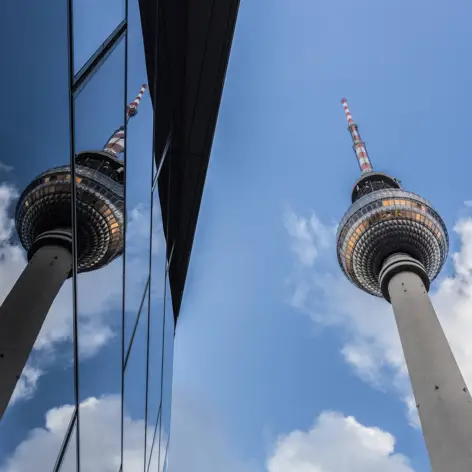
The television tower is one of Berlin's most famous landmarks. With its silver sphere, it dominates photos and images of the capital and attracts millions of visitors every year.
At 368 meters, it is the tallest building in Germany and one of the tallest in Europe. The observation deck at a height of 203 meters offers a view of the whole of Berlin and parts of Brandenburg. On a clear day, the view is up to 40 kilometers wide.
In addition to the observation deck and a panorama bar, there is a revolving restaurant one floor higher. The restaurant rotates on its own axis within an hour. The observation deck and restaurant are very popular with visitors. It is worthwhile for visitors to buy a ticket in advance. If you want to visit the tower spontaneously in good weather, it is best to plan for a waiting time of one to two hours. At the time of construction, building accessibility played little or no role. It is therefore not possible for wheelchair users to visit.
Opened on the 20th anniversary of the founding of the GDR, officials would have liked the name Telespargel to spread, but this name is not common in Berlin. Other nicknames such as Imponierkeule, Protzstengel or St. Walter after Walter Ulbricht were more the result of mockery of the intentions of the GDR officials and did not catch on. The building cannot be assigned to Alexanderplatz. The tower is located right next to Alexanderplatz station, but behind the square.
While it is a tourist magnet and landmark today and offers a beautiful view and photo motif, it had an important function when it was built: the GDR needed a powerful broadcasting facility. Several locations were under discussion until Alexanderplatz in the center of the city was chosen in 1964. After its opening, it was regarded by GDR state propaganda as a symbol of socialist Berlin and was taller than its western counterpart, the Berlin Radio Tower.
It has since become a symbol for the whole of Berlin. The TV Tower can be reached by buses, trains and streetcars that stop at Alexanderplatz. It is located in the Mitte district. If you come by car, there are plenty of parking spaces around Alexanderplatz, but they are not free.
Book your hotel on H-Hotels.com for your stay in Berlin. We offer you the following advantages:
- Book hotels in Berlin at the best price
- Berlin hotels can be booked without a credit card
- Minibar included in all HYPERION Hotels
- Breakfast included in all H2 Hotels
Construction and history of the TV Tower
The television tower was completed within four years after a long planning phase. The rulers of the GDR had been planning the construction of a television tower since the 1950s. Its function was crucial for propaganda.
The aim was nothing less than to reach the entire broadcasting area and millions of inhabitants of the GDR with radio and television. During the planning phase, other locations such as the Müggelberge and the Volkspark Friedrichshain were under discussion. In the Müggelberge, a structure of this height would have hindered air traffic.
The plan to build the tower in the Volkspark failed due to one of the many economic crises. In the end, the decision was made to build the tower in the middle of the city. The television tower was thus not only a broadcasting station, but also a symbol. For the GDR leadership, or more precisely for the Chairman of the State Council, Walter Ulbricht, the tower was the epitome of the superiority of socialist society.
The leading architects of the building included a group of different participants and well-known names such as Gerhard Kosel and Hermann Henselmann. Gerhard Kosel was president of the German Building Academy, but lost oversight of the television tower project due to political disputes.
Hermann Henselmann shaped the image of Alexanderplatz with his design for the Haus des Lehrers and the Congress Hall. The plan for the building envisaged that the tower would be directly visible from all directions in Berlin. This did not correspond to reality at the time, nor does it today due to the high-rise buildings. Nevertheless, the TV tower can still be seen from many points in Berlin.
The opening of the Dresden television tower was even delayed for the prestigious television tower in the capital. After reunification, the television tower remained standing and required numerous renovations and modernizations. This landmark has been a listed building since 1979. In addition to its importance for tourism, the tower still performs an important function as a broadcasting station today: the antennas are used to transmit television and radio programs.

Tower steeped in history
The architecture of the TV Tower
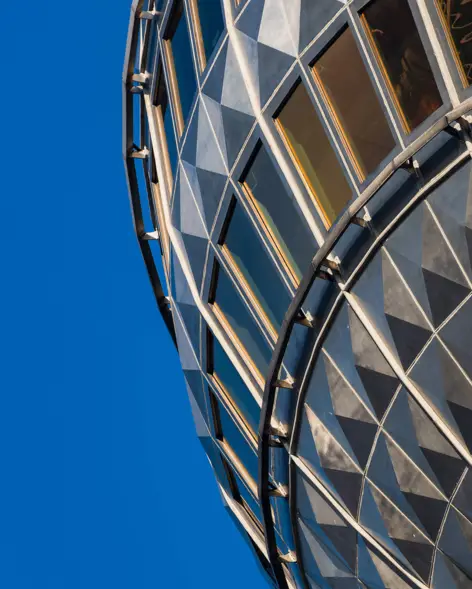
Tower cage of the Berlin television tower
The tower is modeled on the international style. The original idea of celebrating the Soviet Sputnik satellites and the Soviet Union's technological lead lost momentum after the moon landing. Nevertheless, the narrow, tapering tower with the tower basket, the sphere, remains one of the first television towers in this design.
The appreciation of the Soviet space program can also be seen in other buildings in Berlin. These include the Haus des Lehrers on Alexanderplatz and the Café Moskau and Kino International on Karl-Marx-Allee. The avenue is about a 15-minute walk from the tower.
If you look at the tower from a distance, you will recognize the shape of the rocket carrying the satellite. The tower and sphere consist of an inner steel frame, each surrounded by concrete and steel. The irony of history is that this socialist showcase project would not have been realized without materials from the West. Elevators, air conditioning, floodlights and windows came from the capitalist foreign countries demonized by regime propaganda. The stainless steel plates for the cladding of the sphere came from West Germany.
The tower basket, the silver sphere, has a diameter of 32 meters. The outer wall of the silver tower sphere consists of trapezoidal surfaces that make it glow when the sun is in the right position. The outer cladding of the tower sphere has a special feature depending on the position of the sun: it shows a cross. This cross effect is known by the nickname "Revenge of the Pope". After reunification, one of the first modernization tasks was to remove the asbestos insulation. Visitors can recognize the masterpiece of this construction method by the fact that the tower hardly sways noticeably. The viewing platform and restaurant sway a maximum of 15 centimetres.
Below the silver sphere are two rings that serve as a platform for emergencies and can accommodate up to 400 people. In an emergency, there is a staircase with over 900 steps, which offers an alternative to the elevator in the event of a fire. Due to its height, the TV tower is Berlin's highest lightning conductor. For visitors, a thunderstorm only means poor visibility and no danger, as the sphere and the tower act as a Faraday cage.
Berlin from above
The TV tower is open all year round and the opening hours are seasonally adjusted. In the dark days of fall and winter, the TV tower opens later. You can enjoy the view from the platform until midnight. The last elevator ride takes place at 11:30 pm, so that Berlin can also be experienced in the dark.
The elevator ride up is a highlight. The elevators cover the distance to the viewing platform in 40 seconds and inform visitors of the current height. They travel six meters in one second. A slight pressure can be felt in the ears during the ascent. Even though the TV tower has seven floors, only the visitor levels have windows.
All other areas receive natural light via portholes. As no more than 400 people are allowed in the tower sphere for safety reasons, access is limited and there are waiting times when visiting. On the observation floor, visitors can enjoy a comprehensive view of Berlin's sights. The Berlin Cathedral, Unter den Linden and Museum Island can be seen directly nearby.
A little further away, the buildings of the Charité hospital and the Tiergarten park come into view. Display boards explain which sights, buildings and parks can be seen near and far. One floor higher is the Sphere revolving restaurant. If you want to experience Berlin from above on an open viewing platform, the radio tower in the west of Berlin is an alternative to the television tower.

Panorama of Berlin
In a famous neighborhood
After visiting the TV Tower, there are various ways for visitors to discover Berlin. Alexanderplatz station , located right next to the TV Tower, offers the opportunity to reach the whole of Berlin by public transport.
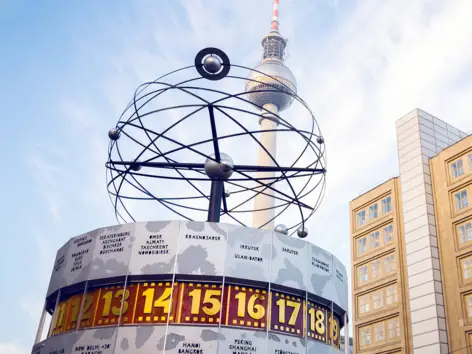
Visitors can reach Potsdam, the capital of Brandenburg with the famous Sanssouci Palace, in an hour from Alexanderplatz. But Alexanderplatz is also worth a visit. There is a world-famous clock here: the Weltzeituhr shows the time around the world. If you want to relax after a visit to the tower, you will find various restaurants and cafés with old Berlin charm in the historic Nikolai Quarter. The route to the Nikolai Quarter leads past the Rotes Rathaus, the seat of Berlin's mayor.
If you are interested in souvenirs, you can choose from various stores around the TV tower. The Alea 101 shopping center is right next to it, while the Rathauspassagen, the Alexa shopping center and the Galeria Kaufhof department store on Alexanderplatz are just a few minutes' walk away.
In the fall, the TV tower is an ideal starting point for a long walk to the buildings that are illuminated during the Festival of Lights. In addition to the tower, these include the Nikolai Church, Berlin Cathedral, Humboldt University and the Brandenburg Gate. On the way to Berlin Cathedral, which is around 15 minutes' walk away, are the Neptune Fountain and St. Mary's Church.
Karl-Marx-Allee, whose buildings are considered the epitome of socialist architecture, is also just a stroll away. Alexanderplatz is a central stop for buses and streetcars. These can be used to explore the west of the city or a popular district in the east, Prenzlauer Berg. The buses travel in all directions, while the streetcars are mainly found in the eastern part of Berlin. Buses and streetcars take Berliners and visitors to Friedrichstraße, Tiergarten, Kurfürstendamm, Potsdamer Platz and the Zoological Garden. Streetcar lines that run to Hackescher Markt and the main railway station stop directly in front of the television tower.