


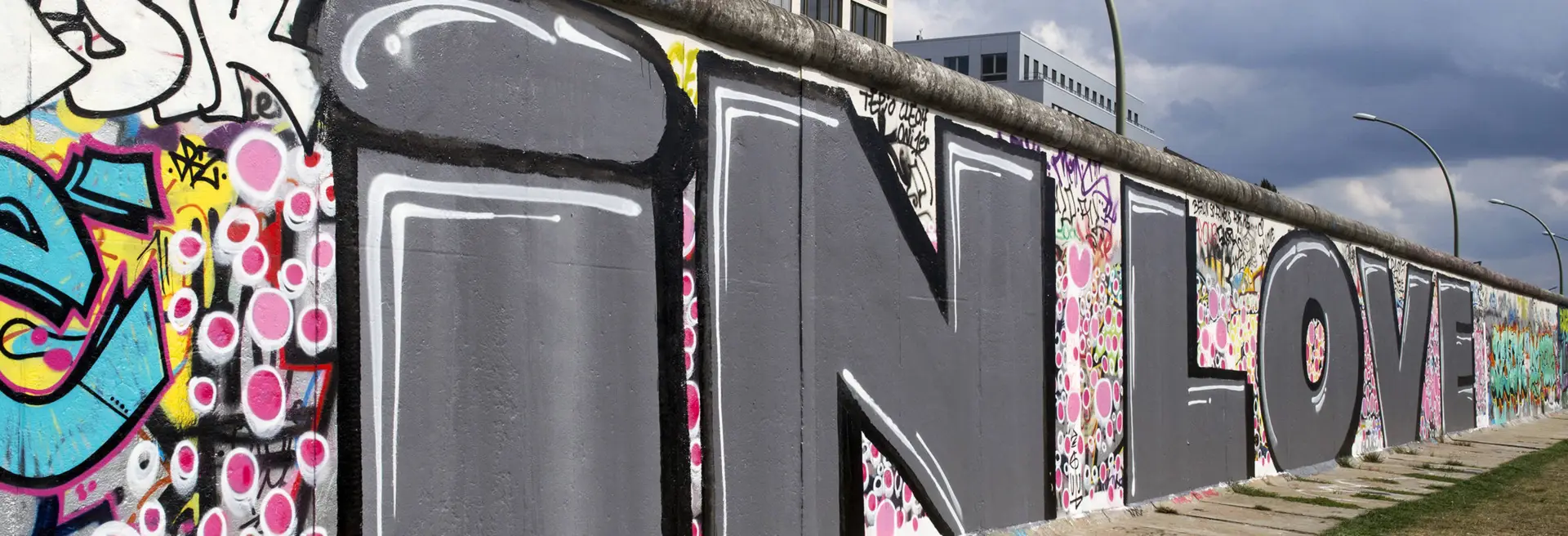
Berlin Wall - historical monument with park, gallery and memorial site
From 1961 to 1989, for more than 28 years, the Berlin Wall shaped the cityscape. It divided the city into East and West over a length of 155 kilometers and surrounded West Berlin.
The border fortifications and the border strip have disappeared and only a few traces of the division of the city can still be found. They are among the sights of the capital. As memorials and monuments, they remind us of German history after the war, of escapes from the GDR and of those who died at the Wall. in 1990, the dismantling of the border fortifications began and the discussion about a monument protection for the Berlin Wall started. Today, where Friedrichshain and Kreuzberg invite visitors to party as a nightlife district, there are few reminders of the Berlin Wall.
Nevertheless, the East Side Gallery and Checkpoint Charlie are among the best-known places where visitors can experience the Berlin Wall and its effects.
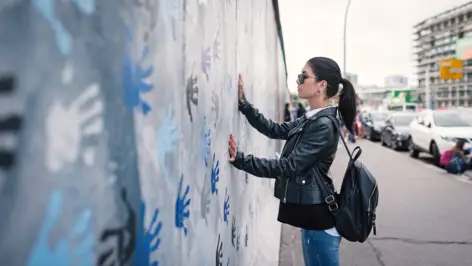
On the trail of Berlin's history

Book your hotel on H-Hotels.com for your stay in Berlin. We offer you the following advantages:
- Book hotels in Berlin at the best price
- Berlin hotels can be booked without a credit card
- Minibar included in all HYPERION Hotels
- Breakfast included in all H2 Hotels

Checkpoint Charlie
The East Side Gallery, painted by artists, is the longest surviving section. At Checkpoint Charlie the border crossing has been rebuilt as a backdrop. The memorial in Bernauer Strasse is the central place of remembrance of the Berlin Wall. The Wall Trail traces its course in Berlin. But other places and museums also focus on the division of Berlin. The memorial in Marienfelde comm emorates the escapes and departures of GDR citizens at the authentic site of the emergency reception camp.
The former prison in Hohenschönhausen is home to the memorial for those politically persecuted in the GDR. A private initiative ensured the preservation of a watchtower of GDR border troops on Kieler Straße. The watchtower is now a memorial to Günter Litfin, the first victim killed by gunfire at the Wall. In many places in Berlin, such as the Brandenburg Gate or Potsdamer Platz, markers and exhibitions remind us that the border was located there.
Traces of the Berlin Wall
Only sections of what was officially known as the anti-fascist protective wall still remain. The course of the border divided the city and was reflected in the everyday lives of East and West Berliners. Remains of the Berlin Wall can be found in Bernauer Strasse, Niederkirchner Strasse and Liesenstrasse. The section there is just 15 meters long and is a listed building. Pieces of the Hinterlandmauer, the part of the Wall that closed off the border to East Berlin, can be found on Leipziger Platz and in the Mauer Park. They also form the East Side Gallery in Friedrichshain, which was painted by artists in the early 1990s.
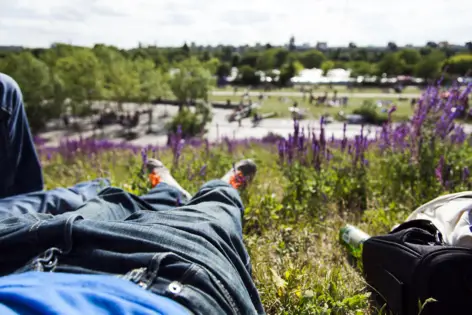
The Wall strip, on the other hand, can still be seen in some areas of Berlin-Mitte, Friedrichshain and Kreuzberg. The Berlin Wall disappeared quickly. But some of the fallow land created by the border and the Hinterlandmauer still exists today. The Mauerpark on Eberswalder Strasse is an example of how a no-man's land was transformed into an open space for Berliners and visitors.
Memories of the Wall
What the separation of a city means can be seen in the ghost stations, those closed stations where the trains passed through. A photo exhibition at Nordbahnhof station shows the history of such stations. The last remnants of the Wall in the government district can be found in the "Parliament of Trees" memorial.
In the nearby Elisabeth Lüders House, the Wall Memorial commemorates the victims of the division of Berlin. In addition to the construction of a border crossing, Checkpoint Charlie in Friedrichstrasse numerous museums. Here, visitors can learn more about the history of the division of Germany and Berlin.
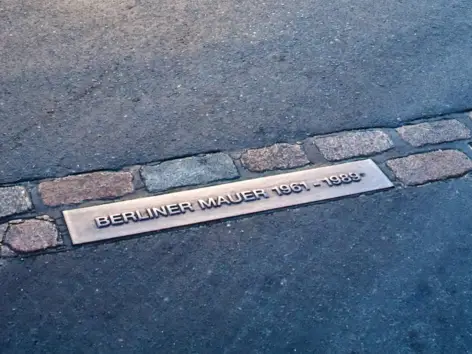
At the Brandenburg Gate, which stood directly on the border at the time of the division, double rows of paving stones in the ground illustrate the course of the Berlin Wall. In the Brandenburg Gate subway station on Pariser Platz, an exhibition provides an overview of the significance of the gate during the division. Near Potsdamer Platz on Erna-Berger-Straße stands one of the last watchtowers. The watchtower can be visited and dates back to the 1970s.
The longest gallery in the world
The most famous piece of the Berlin Wall in the world is the East Side Gallery on Mühlenstraße in Friedrichshain. Millions of visitors have turned it into a tourist attraction and many of the individual pictures on the section of the Wall are postcard motifs and landmarks of the city as part of the Berlin Wall. The gallery stretches from Warschauer Straße and Oberbaumbrücke to Ostbahnhof. It runs along the banks of the Spree for more than a kilometer. It was part of the Hinterlandmauer. The border between East and West Berlin ran directly along the Spree and the banks of the Spree at this point. The death strip was located between the river and the Hinterlandmauer.
After the fall of the Wall, Berlin and especially the districts of Kreuzberg and Friedrichshain became a magnet for artists. In 1990, over a hundred international artists from an all-German artists' initiative immortalized themselves with paintings on the Wall on Mühlenstraße. In West Berlin, it was customary for tourists to leave a painting on the Wall. In the death strip and on the GDR side, such actions were unthinkable.
The GDR side of the construction consisted of rough concrete. Among the most famous paintings are "The Brother's Kiss" by Dimitrij Vrubel and the Trabi breaking through the Berlin Wall by Birgit Kinders. Visitors can discover more than a hundred paintings in a wide variety of styles. They bear witness to the joy and freedom after the fall of the Wall and serve as a monument to peace and reconciliation.

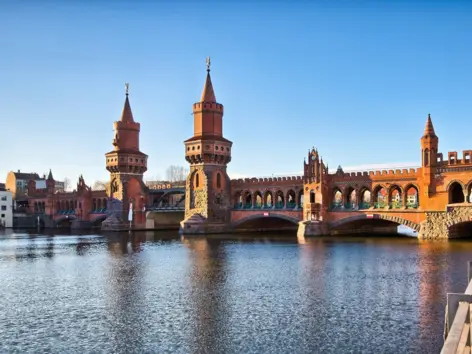
Oberbaum Bridge
The gallery has been a listed building since 1991. This is due to the initiative of the artists who turned a piece of the Berlin Wall into both a work of art and a monument. The site is a tourist attraction and at the same time shows Berlin's striving between building and preserving. The former border strip is now the target of many construction projects.
Office and residential buildings are being built directly on the Spree, and parts of the gallery are making way for these construction projects. The removed sections of the Wall can be seen on a platform a few meters behind the Wall. Back in the 1990s, the artist Kani Alavi founded an artists' initiative that campaigned for the protection of the artworks. Alavi is one of the artists whose works can be seen on the wall. Since 2018, the gallery has been under the care of the Berlin Wall Foundation, which ensures its preservation.
The Wall Museum East Side Gallery is located on Mühlenstraße, just a few meters from the East Side Gallery. It tells the story of the Berlin Wall in a multimedia exhibition. However, the sights at the former Wall are not just the paintings, but also the surroundings. Beyond the Wall, the view opens up to the red Oberbaum Bridge, which connects the districts of Friedrichshain and Kreuzberg. The red brick bridge reveals its Gothic architecture best from a distance. There are landing stages for excursions, restaurants and bars directly on the Spree.
Berlin Wall Memorial
The Berlin Wall Memorial on Bernauer Strasse is the central memorial to the division of Germany in Berlin. It covers a length of more than one kilometer of the former border strip. Of this, 70 meters include a section of the Berlin Wall. Here visitors get an impression of the border fortifications and their construction. Bernauer Strasse between Berlin-Wedding and Mitte was one of the residential areas in which everyday life changed as a result of the construction of the Wall. Many of the residents of the adjacent houses in the GDR fled or left their homes under pressure.
The best-known symbol of the division on Bernauer Strasse is the GDR border soldier jumping over the border fence. A photo of it can be seen on the walls of the houses. On the former border strip, an open-air exhibition with a memorial and archaeological windows illustrates the history of the division of this street. The routes of escape tunnels and the Wall are embedded in the ground and regular church services are held in the reconstructed Chapel of Reconciliation. The central memorial integrates a section of the border fortifications.
The "Window of Remembrance", which tells the life stories of all known victims, was created to commemorate those who died at the Wall. The exhibition with its media stations leads into a newly developed residential area and illustrates the transformation of the city. On the other side of Bernauer Strasse there is a documentation center and an observation tower.
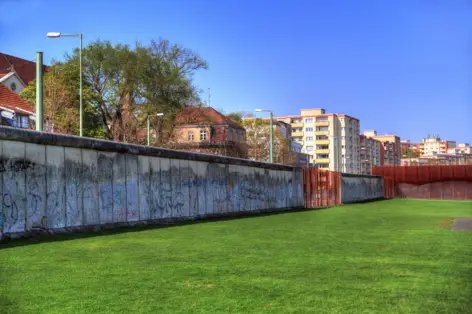
Memorial in Bernauer Strasse
The Berlin Wall Trail
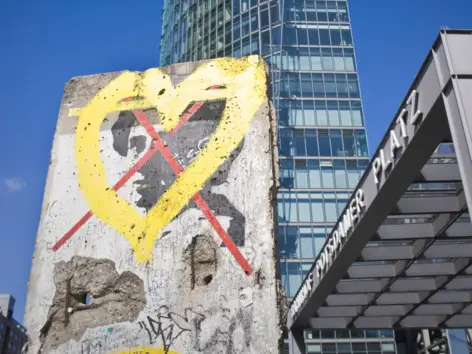
Wall Trail across Potsdamer Platz
The Berlin Wall Trail is a 160-kilometer route that follows the course of the Berlin Wall. Remains of the border fortifications lie along this cycling and hiking route. Along the way there are stations of the Berlin History Mile and information steles. They provide an insight into the historical events on site. For visitors, sections away from the big city give an impression of the Brandenburg countryside and the changing capital.
The trail leads from the city center to areas less frequented by tourists. In Berlin-Mitte, a double row of cobblestones over five kilometers long marks the route. It runs from the East Side Gallery to Bernauer Strasse and passes the Checkpoint Charlie border crossing and Potsdamer Platz. Along the way are numerous memorials and the Topography of Terror site. Here in Niederkirchner Straße there is an approximately 200 meter long section of the Berlin Wall. The Wall Trail in the city center leads past many other Berlin sights.
The entire route of the path is divided into 14 individual tours, which can be followed or hiked individually. The individual routes are between seven and 21 kilometers long. The respective start and end points can be reached by public transport. In the outer areas of the city, the trail leads past lakes, forests and gardens. The route includes sights such as the Glienicke Bridge, which was a famous border crossing, and Glienicke Palace. In the Wannsee section, the House of the Wannsee Conference and the Liebermann Villa line the route.